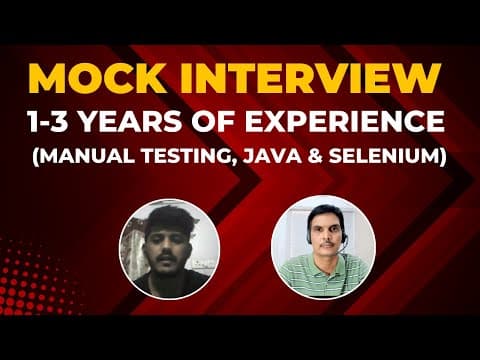
This blog post provides a comprehensive overview of a mock interview focused on manual testing, Java, and Selenium, highlighting key concepts, methodologies, and practical scenarios that candidates should be familiar with to excel in software testing roles.
In this blog post, we delve into a mock interview conducted with Sanju, a software test engineer with three years of experience in manual testing and automation using Selenium. The interview covers various aspects of software testing, methodologies, and programming concepts, providing valuable insights for aspiring testers.
The mock interview begins with a warm welcome and an explanation of the process. Sanju is informed that the interview will be recorded and uploaded to YouTube, and he is encouraged to ask for clarification if he does not understand a question.
Sanju introduces himself, sharing his educational background and work experience. He graduated in 2014 from a government engineering college and has been working as a software test engineer for three years.
Sanju explains that he follows the Agile methodology in his current project. He describes the process of attending sprint meetings with the scrum master, developers, and clients to understand sprint planning. The team lead assigns user stories, which they review to prepare test scenarios and test cases.
Sanju details how he writes test cases in Excel, starting with test scenarios and then developing test steps. He emphasizes the importance of reviewing test cases with the team lead before execution.
Sanju articulates the main purpose of software testing: to ensure the quality of the software before release. He stresses that releasing a product with bugs can lead to customer dissatisfaction, making quality assurance critical.
Sanju explains that before writing test cases, he refers to user stories to understand the application's functionality. He mentions the use of a Requirement Clarification Note (RCM) to address any missing information.
To ensure all requirements are covered, Sanju discusses the use of a Traceability Matrix, which maps test scenarios to test cases, ensuring comprehensive coverage.
Sanju describes the process of executing test cases after the developers release a build. He mentions the importance of reviewing test cases with the team lead and obtaining sign-off before execution.
When a bug is found, Sanju updates it in the bug tracking tool (JIRA) and assigns it to the relevant developer. He emphasizes the need to verify the bug multiple times before reporting it to ensure it is reproducible.
In cases where a developer disputes a reported bug, Sanju explains the importance of communication with the team lead and product owner to resolve conflicts based on the original requirements.
Sanju discusses the concepts of priority and severity in bug reporting. He explains that priority refers to how soon a bug should be fixed, while severity relates to the impact of the bug on the application's functionality.
Sanju provides definitions for key Agile concepts such as epic, story, and task. He explains that an epic is a collection of user stories, while a story represents a specific requirement, and tasks are the activities needed to complete that story.
The interview transitions to programming concepts, where Sanju rates his Java skills as 6.5 out of 10. He answers questions about string comparison, method overloading, and the use of the final keyword in Java.
Sanju lists different types of collections in Java, including lists, sets, and maps. He explains the differences between lists and sets, particularly regarding element order and duplication.
Sanju discusses his experience with Selenium, detailing various locators used in automation scripts. He explains the differences between link text and partial link text, as well as absolute and relative XPath.
Sanju is presented with a scenario involving a button that changes its ID dynamically. He demonstrates how to write a single XPath that can handle both states of the button using the contains method.
Sanju explains the purpose of assertions in testing, differentiating between hard and soft assertions. He emphasizes that assertions are used to validate expected outcomes against actual results.
When asked about challenges faced while writing automation scripts, Sanju mentions exceptions that occur during execution and the need for try-catch blocks to handle them.
The mock interview concludes with feedback for Sanju, highlighting areas for improvement, particularly in programming and automation concepts. The interviewer encourages him to prepare more thoroughly for future interviews, especially given his experience level.
This mock interview serves as a valuable resource for anyone looking to enhance their understanding of manual testing, automation, and the software development lifecycle. By familiarizing themselves with these concepts, candidates can better prepare for real-world interviews and excel in their careers as software testers.