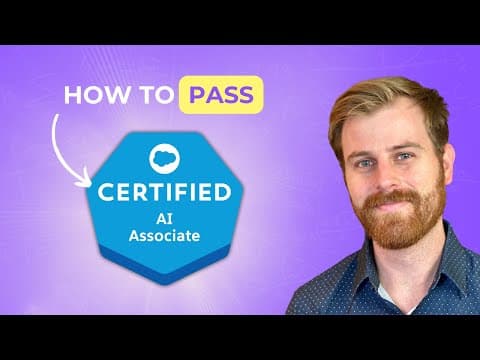
In this blog post, we will summarize the essential information from the Salesforce AI Associate Certification master class. After spending 26 hours working through the AI associate credential prep trail mix on Trailhead, we aim to provide you with a solid foundation for leveraging AI in Salesforce and passing the certification exam. The content is organized into four main sections, reflecting the structure of the exam:
- AI Capabilities in CRM (8% of the exam)
- AI Fundamentals (17% of the exam)
- Data for AI (36% of the exam)
- Ethical Considerations of AI (39% of the exam)
Overview of AI in Salesforce
Before diving into the sections, it's crucial to understand the core concept of the trail mix: with the right data, AI can augment workers' abilities through predictions, insights, and generated content. Data quality, completeness, and accuracy are vital, as AI is designed to enhance human capabilities rather than replace them.
Key Outputs of AI
- Predictions: Estimating the likelihood of specific opportunities being won.
- Insights: Identifying main drivers of winning opportunities based on historical data.
- Generated Content: Creating summaries or automated responses through tools like Einstein Co-Pilot and Einstein Chat Bots.
Section 1: AI Capabilities in CRM (8% of the Exam)
This section focuses on practical AI features that can be implemented immediately. The primary term to know is Einstein, which encompasses all AI capabilities within Salesforce. Key tools include:
- Einstein Bots: Smart assistants for customer channels that use natural language processing.
- Einstein Prediction Builder: A tool for making custom predictions on non-encrypted Salesforce data.
- Einstein Next Best Action: Provides intelligent recommendations based on predictive models.
- Einstein Discovery: Helps understand patterns in company data.
Benefits of Einstein by Cloud
- Sales Cloud: Boosts win rates, analyzes sales cycles, and automates data capture.
- Service Cloud: Accelerates case resolution and creates tailored service replies.
- Marketing Cloud: Uncovers consumer insights and engages effectively with personalized content.
Bonus Tips
- Use the Einstein Readiness Assessor to determine which AI tools are ready for implementation.
- AI can help create lead scores in Sales Cloud and deflect cases in Service Cloud.
Section 2: AI Fundamentals (17% of the Exam)
Understanding AI fundamentals is crucial as we enter a world where AI is integrated into various aspects of business. Key concepts include:
- Intelligence: The ability to acquire and apply knowledge and skills.
- Types of AI: Specialized systems designed for specific tasks, such as numeric predictions, classification, robotic navigation, and natural language processing (NLP).
Key Terms and Definitions
- Machine Learning: Computers learning new things without explicit programming.
- Supervised Learning: Learning from examples.
- Unsupervised Learning: Finding hidden patterns in data.
- Natural Language Processing (NLP): Understanding human language.
Common Concerns with Generative AI
- Hallucinations, data security, plagiarism, user spoofing, and sustainability.
Bonus Tip
- Understand the difference between NLP and Natural Language Understanding (NLU).
Section 3: Data for AI (36% of the Exam)
Data is the fuel for AI, and its quality is paramount. Salesforce has announced free Data Cloud licenses to enhance AI capabilities. Key points include:
- Data Cloud: Integrates data from various applications for a comprehensive customer view.
- Data Literacy: Understanding the types of data (qualitative vs. quantitative) and their characteristics.
Traits of Good Data
- High volume, historical consistency, multivariate, atomic, clean, clear, dimensionally structured, and known pedigree.
Data Aggregation Terms
- Sum, average, median, minimum, maximum, and count.
- Tableau: A suite of products for data visualization, including Tableau Prep Builder, Tableau Desktop, Tableau Server, Tableau Public, and Tableau Mobile.
Bonus Tip
- Granularity in data visualization helps in finding insights.
Section 4: Ethical Considerations of AI (39% of the Exam)
This section emphasizes the importance of ethical practices in AI development. Key principles include:
- Recognize Exclusion: Address biases in problem-solving.
- Learn from Diversity: Adapt to diverse human experiences.
- Solve for One, Extend to Many: Focus on universally important issues.
Guidelines for Trusted Generative AI
- Accuracy
- Safety
- Honesty
- Empowerment
- Sustainability
Trusted AI Principles
- Responsible
- Accountable
- Transparent
- Empowering
- Inclusive
Bonus Resource
- Access the ethical AI practice maturity model for further insights.
Conclusion
By understanding these key concepts and utilizing the provided tips, you will be well-prepared to tackle the Salesforce AI Associate Certification exam. Remember, if you don't pass on your first attempt, there is a free retake available. Good luck, and may you achieve your certification with confidence!