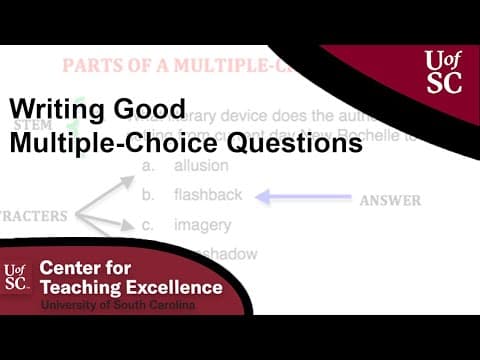
This blog post explores the essential principles and strategies for crafting effective multiple choice questions that assess higher-level critical thinking skills, ensuring clarity, fairness, and alignment with learning outcomes.
Writing effective multiple choice questions is a crucial skill for educators aiming to assess student learning accurately. In this blog post, we will explore the common pitfalls in question design, the qualities of good multiple choice questions, and strategies for crafting questions that promote higher-level critical thinking.
Before diving into the mechanics of question writing, it's important to consider the types of multiple choice questions that students often detest. Common complaints include:
These frustrations highlight the need for clarity and relevance in question design.
When writing multiple choice questions, educators should always align them with the learning outcomes of the course. The goal is not to create a trivia game but to assess students' understanding and ability to apply knowledge. Effective questions should:
The stem of the question should be meaningful and clear, presenting a single idea or problem that focuses on a specific learning outcome. Avoid vague or overly complex wording that could confuse students.
Questions should accurately assess the knowledge and skills they are intended to measure. This requires careful alignment with course objectives and learning outcomes.
Utilize Bloom's Taxonomy to ensure questions span a range of cognitive levels, from basic recall to higher-order thinking skills such as analysis and evaluation.
Questions should be challenging yet appropriate for the average student’s ability level. An exam average that is too low may indicate issues with question difficulty or student preparedness.
Ensure that examples and scenarios used in questions are inclusive and accessible to all students, avoiding assumptions about their experiences.
Bloom's Taxonomy provides a framework for writing questions that target different levels of cognitive processing. Here are some action verbs associated with each level:
To assess higher-level thinking, consider using questions that require students to apply their knowledge in context. For example, instead of asking for definitions, present a scenario where students must analyze information and make a decision based on their understanding.
Writing effective multiple choice questions is a skill that requires practice and attention to detail. By focusing on clarity, validity, and the principles outlined in this post, educators can create assessments that truly reflect student learning and promote critical thinking. Remember, the goal is to assess understanding, not to create a guessing game. With these strategies, you can enhance your question-writing skills and improve the assessment experience for your students.