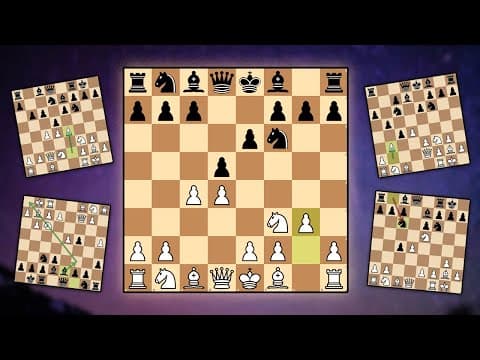
The Catalan opening is a popular choice among elite players and is also effective at club and amateur levels. This blog post will cover 20 essential ideas that every player should know to excel in the Catalan.
Understanding the Catalan Opening
The Catalan typically arises from various move orders, with one of the most common being the Queen's Gambit. The sequence often begins with 1. d4 Nf6 2. c4 e6 3. g3, which avoids the Nimzo-Indian and Queen's Indian defenses. The Catalan can also emerge from 1. Nf3 or 1. c4, leading to similar structures.
The Closed Catalan
The closed Catalan occurs when Black refrains from capturing on c4, opting instead to develop their pieces. Common setups involve moves like ...e7, ...d6, and ...c6. Understanding this structure is crucial for players facing the Catalan.
Key Ideas in the Closed Catalan
- Avoiding cxd5: White should avoid taking on d5 too early, as this opens up Black's position and allows their pieces to develop more freely.
- Queen c2: This move supports the e4 break and prepares for central control.
- E4 Break: The move e4 is a critical idea in the Catalan, allowing White to gain space and challenge Black's center.
- Knight Development: Developing the knight to d2 instead of c3 can be advantageous, as it supports the e4 break without blocking the c-file.
- Bishop Placement: Placing the bishop on g2 is essential for controlling the long diagonal and exerting pressure on Black's position.
Common Responses from Black
- B6 Setup: If Black plays ...b6, White can respond with e4, aiming to open the center and capitalize on Black's passive setup.
- Knight bd7: This move often leads to a symmetrical structure, but White can maintain an advantage with careful play.
- C6 and d5: Black may try to solidify their position with ...c6 and ...d5, but this can lead to weaknesses that White can exploit.
The Open Catalan
The open Catalan arises when Black captures on c4 early, either immediately or after developing their pieces. This leads to dynamic positions where both sides must be vigilant.
Key Ideas in the Open Catalan
- Catalan Bishop: White's light-squared bishop on g2 becomes a powerful piece, often dominating the long diagonal.
- Countering Black's Plans: Black must be careful not to allow White's bishop to become too active, as this can lead to a long-term disadvantage.
- Central Control: White should aim to control the center with pawns on d4 and e4, while also preparing to challenge Black's pawn structure.
- Bishop D7 and C6: Black often plays ...Bishop D7 and ...C6 to neutralize White's bishop, but this can lead to passive positions.
- Pawn Breaks: The move e4 is crucial for White to open the position and create threats against Black's setup.
Tactical Themes
- Knight Maneuvers: Knights can be repositioned to e5 or f5 to create pressure on Black's position.
- Rook Activity: Rooks should be centralized on the e-file or c-file to maximize their influence.
- Pawn Structure: Understanding the implications of pawn structure is vital; White often aims for a pawn majority on the kingside.
Move Orders and Transpositions
Understanding move orders is essential in the Catalan. Players should be aware of how different sequences can lead to various structures and plans. For example, playing 1. Nf3 or 1. c4 can lead to transpositions into the Catalan, allowing players to avoid certain lines.
Conclusion
The Catalan opening is rich with strategic ideas and tactical themes. By mastering these 20 essential concepts, players can enhance their understanding and performance in this popular opening. Whether you are a beginner or an experienced player, these insights will help you navigate the complexities of the Catalan and improve your overall chess skills.