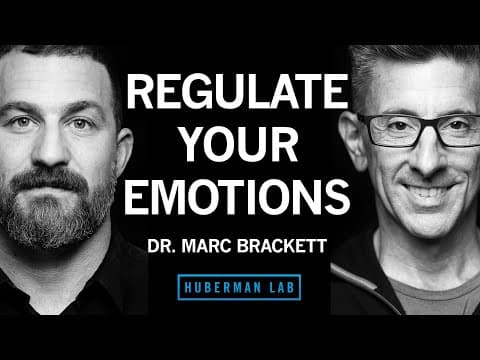
Dr. Marc Brackett, a leading expert on emotional intelligence, discusses the importance of understanding and regulating emotions for better relationships and quality of life. He introduces the RULER framework, which emphasizes recognizing, understanding, labeling, expressing, and regulating emotions. The conversation highlights the significance of emotional education in schools and the impact of emotional awareness on personal and professional success.
Welcome to the Huberman Lab podcast, where we discuss science and science-based tools for everyday life. In today's episode, I had the pleasure of speaking with Dr. Marc Brackett, a professor of psychology at Yale University and the director of the Yale Center for Emotional Intelligence. Dr. Brackett is one of the world's foremost experts on emotions, their meanings, and how they regulate our relationships with ourselves and others.
Emotions are an integral part of our lives, present from birth until death. Just as we learn to navigate our physical bodies, we must also learn to work with our emotions to enhance our quality of life. While we are often encouraged to pay attention to our emotions, we are also told not to take them too seriously or react impulsively. Dr. Brackett provides a structured roadmap for understanding and engaging with our emotions, which can lead to improved relationships and overall well-being.
Dr. Brackett introduces the RULER framework, which consists of five key skills:
Traditionally, emotional intelligence tests relied on static images of facial expressions. However, Dr. Brackett and his colleagues have developed more innovative assessments that include video clips and vocal tones to better capture the nuances of emotional expression. This evolution in measurement reflects a deeper understanding of emotional intelligence as a set of skills rather than a fixed trait.
A significant aspect of emotional intelligence is the ability to articulate our feelings accurately. Dr. Brackett emphasizes the importance of having a rich vocabulary for emotions. For instance, distinguishing between feelings of anger, disappointment, and frustration can lead to better emotional regulation and conflict resolution. The ability to label emotions accurately allows individuals to communicate their feelings effectively and seek appropriate support.
In today's digital age, the use of emojis and text messaging has transformed how we communicate emotions. While emojis can simplify emotional expression, they may also lead to misunderstandings and a lack of emotional granularity. Dr. Brackett warns that relying too heavily on these tools can degrade our emotional intelligence and hinder our ability to connect with others meaningfully.
Dr. Brackett advocates for integrating emotional education into school curricula. By teaching children to recognize and understand their emotions, we can foster a generation that is more emotionally intelligent and resilient. The RULER approach has been implemented in thousands of schools, helping students develop the skills necessary to navigate their emotional lives effectively.
Emotions play a crucial role in learning and decision-making. When students feel engaged and emotionally supported, they are more likely to succeed academically. Dr. Brackett's research shows that positive emotional experiences can enhance cognitive performance, while negative emotions can hinder learning. Therefore, creating emotionally supportive environments in schools is essential for fostering academic success.
Dr. Marc Brackett's insights into emotional intelligence provide valuable tools for improving our relationships with ourselves and others. By understanding and regulating our emotions, we can enhance our quality of life and create more supportive environments in our schools and workplaces. The RULER framework serves as a practical guide for developing emotional intelligence at any stage of life, empowering individuals to navigate their emotional landscapes with confidence.
In closing, I encourage everyone to explore Dr. Brackett's work and consider how emotional intelligence can be integrated into your daily life. Thank you for joining us for this enlightening discussion on emotions and emotional intelligence.