This blog post provides a detailed introduction to arithmetic sequences and series, explaining their definitions, differences from geometric sequences, how to calculate means, find terms, and compute sums, along with practical examples and formulas.
Arithmetic sequences and series are fundamental concepts in mathematics that involve patterns of numbers. This blog post will explore what arithmetic sequences and series are, how they differ from geometric sequences, and how to calculate various properties related to them.
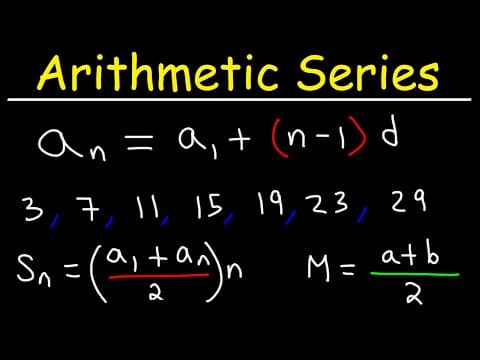
An arithmetic sequence is a list of numbers in which the difference between consecutive terms is constant. This difference is known as the common difference. For example, the sequence 3, 7, 11, 15, 19, 23, 27 is an arithmetic sequence where the common difference is 4.
In contrast, a geometric sequence is defined by a common ratio between consecutive terms. For instance, the sequence 3, 6, 12, 24, 48, 96, 192 is a geometric sequence where each term is multiplied by 2 to get the next term.
The arithmetic mean of two numbers is simply the average of those numbers. It can be calculated using the formula:
[ ext{Arithmetic Mean} = \frac{a + b}{2} ]
To find the arithmetic mean of 3 and 11:
Similarly, for 7 and 23:
The formula to find the nth term of an arithmetic sequence is:
[ a_n = a_1 + (n - 1) \cdot d ]
Where:
To find the 5th term of the sequence 3, 7, 11, 15, 19:
The partial sum of the first n terms of an arithmetic sequence can be calculated using the formula:
[ S_n = \frac{(a_1 + a_n)}{2} \cdot n ]
Where:
To find the sum of the first 7 terms of the sequence 3, 7, 11, 15, 19, 23, 27:
A series is the sum of the terms of a sequence. For example, the sum of the arithmetic sequence 3, 7, 11, 15, 19, 23, 27 is an arithmetic series.
To solidify your understanding, consider the following practice problems:
Identify whether the following is a sequence or series, and whether it is finite or infinite:
Write the first four terms of the sequence defined by ( a_n = 3n - 7 ).
Calculate the sum of the first 300 natural numbers.
Arithmetic sequences and series are essential concepts in mathematics that help in understanding patterns and calculations involving numbers. By mastering the definitions, formulas, and calculations associated with these sequences, you can enhance your mathematical skills and problem-solving abilities. Practice with various examples to gain confidence in these concepts.