This blog post provides a detailed overview of AS Level Organic Chemistry, covering essential concepts such as types of formulas, homologous series, nomenclature, functional groups, reaction types, and isomerism, aimed at students preparing for the CIE exam.
Welcome to the world of organic chemistry! This guide serves as an introduction to AS Level Organic Chemistry, specifically tailored for students preparing for the Cambridge International Examinations (CIE). We will explore various organic compounds, including isotopes, isomers, and essential chemical reactions.
Understanding the different types of chemical formulas is crucial in organic chemistry. Here are the main types:
A general formula is an algebraic representation applicable to a family of compounds. For example, the general formula for alkanes is CnH2n+2, where n represents the number of carbon atoms.
The molecular formula indicates the actual number of atoms in a molecule. For instance, ethane has the molecular formula C2H6, meaning it contains two carbon atoms and six hydrogen atoms.
The empirical formula represents the simplest whole number ratio of atoms in a compound. For ethane (C2H6), the empirical formula is CH3.
This formula shows the arrangement of atoms in a molecule without depicting all the bonds. For example, the structural formula for butanol is CH3CH2CH2CH2OH.
A skeletal formula illustrates the carbon skeleton, omitting hydrogen atoms but including functional groups. Each vertex represents a carbon atom, simplifying the representation of large molecules.
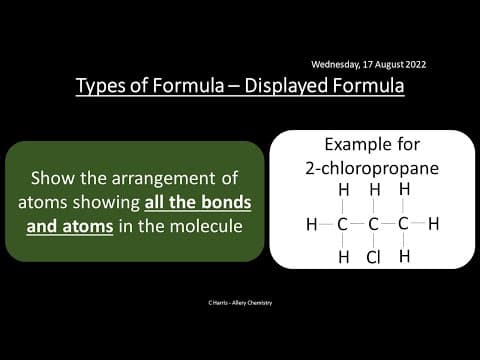
Displayed formulas show all atoms and bonds in a molecule. For example, the displayed formula for 2-chloropropane includes all bonds and atoms clearly.
A homologous series is a group of compounds sharing the same functional group and general formula. For example, alcohols follow the general formula CnH2n+1OH. As you progress through the series, each successive member differs by a CH2 unit.
Naming organic compounds can be complex, but it follows systematic rules established by the International Union of Pure and Applied Chemistry (IUPAC). Here are the steps to name a compound:
Functional groups are specific groups of atoms that determine the chemical properties of a compound. Here are some key functional groups:
Organic reactions can be categorized into several types:
Isomers are compounds with the same molecular formula but different structures. There are two main types:
These have the same molecular formula but different structural arrangements. Types include:
Stereoisomers have the same structural formula but differ in the spatial arrangement of atoms. Key types include:
This introduction to AS Level Organic Chemistry covers essential concepts that will aid in your understanding and preparation for the CIE exam. Familiarizing yourself with the types of formulas, homologous series, nomenclature, functional groups, reaction types, and isomerism will provide a solid foundation for further studies in organic chemistry.
For more detailed study, consider reviewing additional resources or purchasing supplementary materials to enhance your learning experience.