This blog post provides a comprehensive overview of basic trigonometry concepts, focusing on right triangles, key functions, and problem-solving techniques. It emphasizes the importance of organized note-taking and understanding mathematical principles to effectively tackle trigonometric problems.
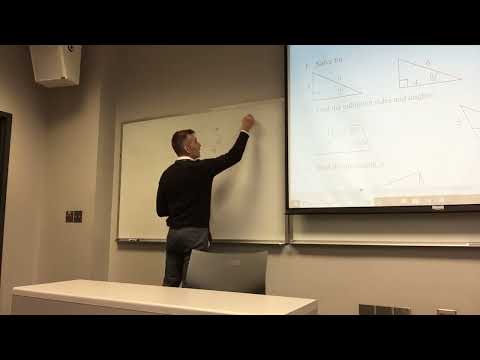
In this lecture, we delve into the fundamentals of trigonometry, particularly focusing on right triangles. The aim is to build a solid foundation for understanding trigonometric functions and their applications in solving problems. This guide will walk you through the essential concepts and techniques necessary for mastering basic trigonometry.
Before we dive into the mathematical concepts, it's crucial to highlight the significance of effective note-taking. The notes you create during this course will be invaluable for exams and quizzes, as they will be open-note. Here are some tips for organizing your notes:
A right triangle is defined by one angle measuring 90 degrees. In trigonometry, we focus on three primary functions:
The Pythagorean theorem is fundamental in trigonometry and states that in a right triangle, the square of the hypotenuse (c) is equal to the sum of the squares of the other two sides (a and b):
[ c^2 = a^2 + b^2 ]
Another essential concept is that the sum of the angles in any triangle is always 180 degrees. This principle will be useful as we solve various problems.
When solving a trigonometric problem, start by identifying the known values. For example, if you have a right triangle with one side length known, you can use the Pythagorean theorem to find the other side lengths.
For instance, if you know side length a = 3 and hypotenuse c = 6, you can find side length b:
Once you have the side lengths, you can find the angles. For example, to find angle ( \Theta ) using sine:
With one angle known, you can easily find the other angle in the triangle:
Understanding the basics of trigonometry is essential for solving problems related to right triangles. By organizing your notes, mastering the Pythagorean theorem, and applying trigonometric functions, you can effectively tackle various mathematical challenges. Remember to practice regularly and seek clarification on any concepts that are unclear. With time and effort, you will gain confidence in your trigonometric skills.