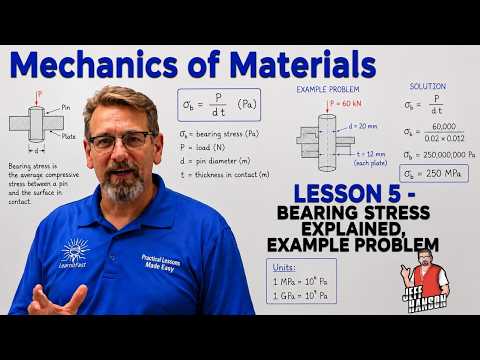
This blog post explains the concept of bearing stress in mechanics of materials, differentiating it from other types of stress, and provides a detailed example problem to illustrate its calculation and application.
In the field of solid mechanics and mechanics of materials, students often encounter various types of stress, including normal stress and shear stress. One particular type that can be confusing is bearing stress. This blog post aims to clarify what bearing stress is, how it is calculated, and its practical applications through a detailed example problem.
Bearing stress is a type of stress that occurs when one object exerts a force on another over a specific area. It can be thought of as a compressive stress, similar to normal stress, which is defined as the force divided by the area (p/a). In essence, bearing stress is the result of a force being applied over a contact area between two surfaces.
To illustrate the concept of bearing stress, let’s work through an example problem involving a post with a bar and a bolt.
Consider a post with a bar on top that has a force (P) applied at one end. For this example, let’s assume:
In this scenario, the bolt connects the bar to the post. When the force is applied, it creates a shear force on the bolt and a bearing stress between the bolt and the bar. The first step in solving this problem is to create a free body diagram to visualize the forces acting on the system.
To find the average shear stress on the bolt, we use the formula:
[ \tau = \frac{V}{A} ]
Where:
The area of the bolt can be calculated using the radius:
Now, substituting the values:
[ \tau = \frac{446.85 \text{ N}}{63.62 \text{ mm}^2} = 7.02 \text{ MPa} ]
Next, we need to calculate the bearing stress exerted by the bolt on the bar. The formula for bearing stress is:
[ \sigma = \frac{P}{A} ]
Where P is the force exerted by the bolt on the bar, and A is the projected area of contact. The projected area is calculated as:
Now substituting the values:
[ \sigma = \frac{446.85 \text{ N}}{135 \text{ mm}^2} = 3.31 \text{ MPa} ]
In summary, bearing stress is a crucial concept in mechanics of materials that describes the stress experienced at the contact area between two objects. Through the example problem, we demonstrated how to calculate both shear stress and bearing stress, highlighting their significance in structural applications. Understanding these concepts is essential for engineers and students alike as they navigate the complexities of material mechanics.
Thank you for reading, and I hope this explanation helps clarify the concept of bearing stress for you!