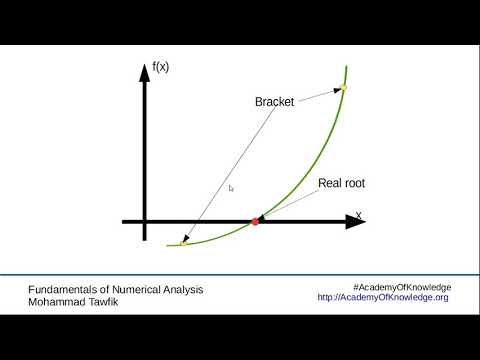
Bracketing methods are effective techniques for finding roots of nonlinear equations by ensuring a solution exists between two points where the function changes sign. This blog post introduces the concept of bracketing methods, focusing on the bisection method as a straightforward and powerful approach.
In the realm of numerical analysis, solving nonlinear equations can often be a challenging task. However, bracketing methods provide a reliable approach to finding solutions. This blog post delves into the fundamentals of bracketing methods, their significance, and introduces the bisection method as a primary technique for root-finding.
Bracketing methods are numerical techniques used to find the roots of nonlinear equations. A root of a function is defined as the value of x where the function f(x) equals zero. The unique property of bracketing methods is their ability to guarantee the existence of a solution, provided the function is continuous.
To understand bracketing methods, we first need to grasp the concept of a root. Consider an arbitrary continuous function that changes its value and crosses the x-axis at some point. This intersection point is referred to as the root of the function. The general idea behind finding a root is to identify two values of x, denoted as x1 and x2, between which the function changes its sign—from positive to negative or vice versa.
For bracketing methods to be applicable, it is essential to establish a sign change between the two points. Mathematically, this can be expressed as:
This condition indicates that if one function value is positive and the other is negative, their product will be less than zero. Conversely, if both values share the same sign, the product will be greater than or equal to zero, which does not satisfy the requirement for bracketing.
Among the various bracketing methods, the bisection method stands out as one of the simplest and most effective techniques for finding roots. Despite its straightforward nature, the bisection method is a powerful tool used in numerous applications.
The bisection method operates by repeatedly narrowing down the interval [x1, x2] where the sign change occurs. Here’s a brief overview of the steps involved in the bisection method:
Bracketing methods, particularly the bisection method, provide a systematic approach to solving nonlinear equations. Their simplicity and reliability make them invaluable in numerical analysis. In the next lesson, we will explore the bisection method in greater detail, showcasing its applications and effectiveness in finding roots of various functions. Stay tuned for more insights into numerical analysis techniques!