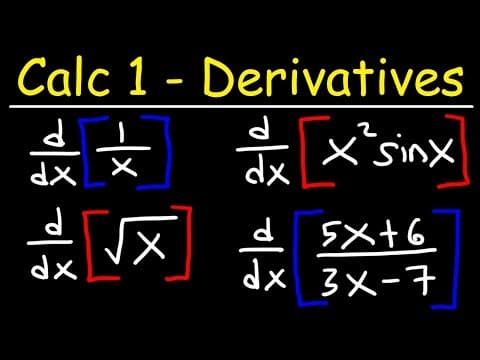
This blog post provides a detailed overview of derivatives in calculus, including definitions, rules for finding derivatives of various functions, and practical examples. It covers the power rule, constant multiple rule, and the concept of tangent and secant lines, along with the application of derivatives in real-world scenarios.
In this lesson, we will focus on finding the derivative of a function, a fundamental concept in calculus. Understanding derivatives is crucial for analyzing the behavior of functions and their rates of change.
A derivative is a function that gives you the slope of another function at a specific x value. For example, if we have a constant function, such as f(x) = 8, the graph would be a straight line at y = 8. The slope of this line is zero, which means the derivative of this constant function is also zero.
The derivative of any constant is equal to zero. For instance:
To find the derivative of a monomial, we can use the power rule. The power rule states that the derivative of a variable raised to a constant (x^n) is given by:
[ \frac{d}{dx}(x^n) = n \cdot x^{n-1} ]
Using the power rule:
When dealing with a constant multiplied by a function, we can apply the constant multiple rule. This rule states:
[ \frac{d}{dx}(C \cdot f(x)) = C \cdot f'(x) ]
For f(x) = 4x^7:
To find the derivative of a polynomial function, differentiate each term separately using the power rule.
The derivative can also be defined using limits:
[ f'(x) = \lim_{h \to 0} \frac{f(x+h) - f(x)}{h} ]
To confirm that the derivative of f(x) = x^2 is 2x:
The derivative provides the slope of the tangent line at a specific point on the curve. A tangent line touches the curve at one point, while a secant line intersects the curve at two points.
Derivatives are used to find rates of change in various fields, such as physics, economics, and biology. For example, in physics, the derivative of position with respect to time gives velocity.
In summary, derivatives are a powerful tool in calculus that help us understand the behavior of functions. By applying rules such as the power rule and constant multiple rule, we can find the derivatives of various functions, analyze slopes of tangent lines, and apply these concepts to real-world problems. Understanding these principles is essential for further studies in calculus and its applications.