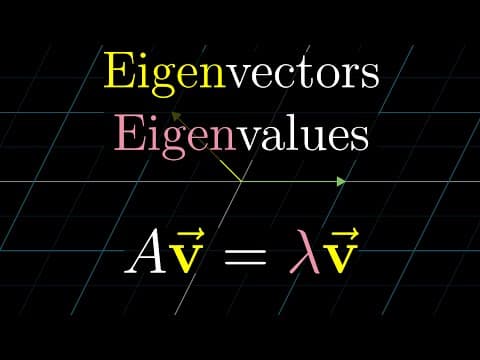
This blog post explores the concepts of eigenvectors and eigenvalues, explaining their significance in linear transformations, how to compute them, and their applications in simplifying complex matrix operations.
Eigenvectors and eigenvalues are fundamental concepts in linear algebra that many students find unintuitive. Often, questions arise such as, "Why are we studying this?" and "What does it actually mean?" Unfortunately, these questions are frequently left unanswered amidst complex computations. This post aims to clarify these concepts through visualization and foundational understanding.
The difficulty in grasping eigenvectors and eigenvalues often stems from a lack of visual understanding of preceding topics in linear algebra. Key concepts such as matrices as linear transformations, determinants, linear systems of equations, and change of basis are crucial for comprehending eigenvectors and eigenvalues. Without a solid foundation in these areas, students may struggle to understand the significance of eigenthings.
To illustrate the concept, consider a linear transformation in two dimensions. For example, a transformation that moves the basis vector i-hat to the coordinates (3, 0) and j-hat to (1, 2) can be represented by a matrix with columns [3, 0] and [1, 2].
When focusing on a specific vector, we can analyze how it behaves under this transformation. Most vectors will not remain on their original span after the transformation; they will be altered in direction. However, some special vectors, known as eigenvectors, will remain on their span, merely being stretched or squished by a scalar factor.
In our example, the basis vector i-hat is an eigenvector because it is stretched by a factor of 3 and remains on the x-axis. Similarly, the vector (-1, 1) is another eigenvector, stretched by a factor of 2. The eigenvalue associated with each eigenvector indicates the factor by which the vector is stretched or squished.
It is important to note that eigenvalues can also be negative, indicating a flip in direction. For instance, an eigenvector with an eigenvalue of -1/2 would be flipped and squished by a factor of 1/2, yet it would still remain on its span.
Understanding eigenvectors and eigenvalues can simplify complex transformations. For example, in three-dimensional rotations, finding an eigenvector allows us to identify the axis of rotation. This perspective is much easier to work with than dealing with the entire 3x3 matrix associated with the transformation. In this case, the corresponding eigenvalue would be 1, as rotations do not change the length of vectors.
To mathematically define eigenvectors and eigenvalues, consider a matrix A representing a transformation, a vector v as the eigenvector, and lambda (λ) as the corresponding eigenvalue. The relationship can be expressed as:
A * v = λ * v
This equation states that the matrix-vector product A times v yields the same result as scaling the eigenvector v by the eigenvalue λ. To find eigenvectors and eigenvalues, we need to solve for v and λ that satisfy this equation.
To find eigenvalues, we can rewrite the equation in a more manageable form. By subtracting λ times the identity matrix from A, we create a new matrix (A - λI). We seek a non-zero vector v such that:
(A - λI) * v = 0
This equation implies that the determinant of (A - λI) must be zero, indicating that the transformation squishes space into a lower dimension. By adjusting λ, we can find values that make the determinant zero, revealing potential eigenvalues.
Consider a matrix A with columns [2, 1] and [2, 3]. By subtracting λ from the diagonal entries and computing the determinant, we derive a quadratic polynomial. The eigenvalues can be determined by finding the roots of this polynomial, which in this case are λ = 2 and λ = 3.
To find the corresponding eigenvectors, we substitute these eigenvalues back into the altered matrix and solve for the vectors that yield zero. For λ = 2, the solutions correspond to vectors along the diagonal line spanned by (-1, 1), confirming that these vectors are stretched by a factor of 2.
It is essential to recognize that not all transformations possess eigenvectors. For instance, a 90-degree rotation does not have any eigenvectors since it rotates every vector off its span. The determinant of the associated matrix yields imaginary eigenvalues, indicating the absence of real eigenvectors.
An eigenbasis occurs when the basis vectors of a transformation are also eigenvectors. In such cases, the transformation can be represented by a diagonal matrix, where the diagonal entries are the eigenvalues. Diagonal matrices simplify computations, especially when raising matrices to high powers, as each basis vector is merely scaled by its corresponding eigenvalue.
Understanding eigenvectors and eigenvalues is crucial for simplifying complex linear transformations and enhancing computational efficiency. By visualizing these concepts and grasping their mathematical foundations, students can gain a deeper appreciation for the elegance of linear algebra. The next step in this exploration will delve into abstract vector spaces, further expanding our understanding of these fundamental mathematical principles.