This blog post explores the four main types of function operations in Algebra 2: addition, subtraction, multiplication, and division. It provides detailed explanations and examples for each operation, including graphical representations and domain and range considerations.
In this lesson, we will delve into the concept of function operations, a fundamental topic in Algebra 2. Function operations include addition, subtraction, multiplication, and division of functions. Understanding these operations is crucial for solving complex mathematical problems and for further studies in mathematics.
Function operations involve combining two functions to produce a new function. The four primary operations are:
Each operation has its own rules and methods for execution, which we will explore in detail.
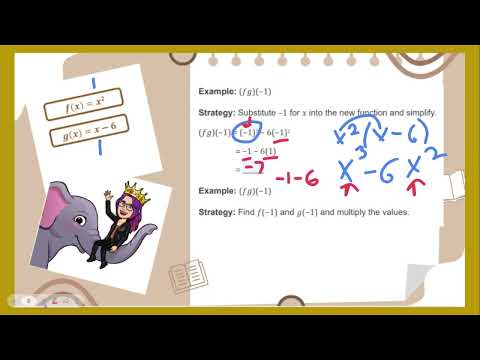
To add two functions, we denote them as F and G. For example, if we want to find (F + G)(-1), we first evaluate F and G at x = -1.
Subtracting functions follows a similar process. We denote the subtraction as (F - G).
When adding or subtracting functions graphically, we can visualize the results on a coordinate plane. For instance, if we have two functions F and G, their sum H can be represented as:
The domain of a function is the set of all possible input values (x-values), while the range is the set of all possible output values (y-values). For the sum of functions:
Multiplying functions involves taking two functions and multiplying their outputs.
Dividing functions requires careful consideration of the denominator to avoid undefined values.
When multiplying binomial functions, we use the distributive property. For example:
Combining like terms gives us the final product.
When simplifying a quotient, we must ensure that the denominator does not equal zero. For example:
Understanding function operations is essential for mastering Algebra 2. By practicing addition, subtraction, multiplication, and division of functions, students can enhance their problem-solving skills and prepare for more advanced mathematical concepts. Thank you for joining this lesson, and we look forward to seeing you in the next one!