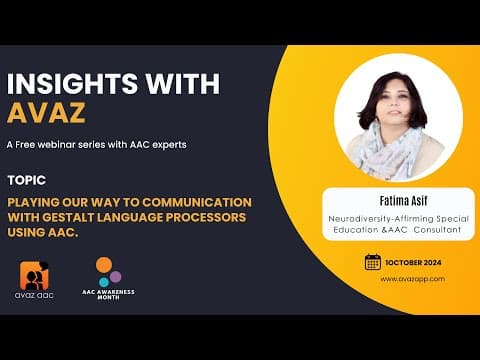
My name is FMA, and I am passionate about creating happy places and bringing joy to autistic and neurodiverse learners through effective communication. Today, I am excited to discuss the significant impact of child-led play on communication for Gestalt Language Processors (GLPs) using Augmentative and Alternative Communication (AAC). Understanding GLPs is crucial as many autistic individuals acquire language through what we refer to as Gestalt language development.
What is a Gestalt Language Processor?
Gestalt Language Processors can be minimally speaking, speaking, or non-speaking. They often exhibit several common characteristics:
- Strong Visual and Auditory Memory: GLPs can remember directions to favorite places after just one visit. They may also repeat lines from their favorite TV shows or videos, often using echolalia to communicate.
- Echolalia: This is the repetition of phrases or sentences heard from others, often used in the same context as originally heard. For example, a child might sing or hum their favorite songs but struggle to use language to express basic wants and needs.
- Preference for Screen Time: GLPs may watch the same clips repeatedly, seeking language or context that brings them joy.
- Musical Inclination: Many GLPs show a strong affinity for music, often learning better through musical contexts.
- Long Utterances with Rich Intonation: Even before they can produce clear speech, GLPs may attempt to create long strings of sounds with rich inflection.
Identifying a Gestalt Language Processor
To determine if a child is a GLP, look for signs such as:
- Difficulty with pronoun use, often leading to pronoun reversal (e.g., saying "you" when they mean "I").
- A tendency to keep toys in sets, becoming upset if a piece is missing.
- Repetitive use of phrases or scripts from media, which may not always convey their immediate needs.
Stages of Gestalt Language Development
Gestalt language development is a natural process that progresses through four main stages:
- Delayed Echolalia: The child uses whole phrases or sounds from original sources.
- Mitigation: The child begins to notice patterns and breaks down phrases into smaller units.
- Isolation: The child isolates single words from phrases and starts combining them into two-word phrases.
- Self-Generated Communication: The child begins to create their own novel utterances, marking a significant milestone in language development.
The Importance of Play in Communication
Play is essential for communication development in GLPs. It should be self-chosen, self-directed, and intrinsically motivated. Understanding what constitutes child-led play is crucial:
- Freedom to Choose: Children should have the autonomy to select activities that bring them joy.
- Freedom to Change: Children should be able to switch activities if they lose interest.
- Freedom to End: Children should have the option to stop an activity whenever they wish.
Strategies to Support Communication Through Play
To effectively support GLPs in their communication journey, consider the following strategies:
- Model Language: Use rich intonation and descriptive language that aligns with the child's actions during play.
- Imitate and Acknowledge: If a child expresses something unclear, repeat it back to them. This encourages clarification and builds communication.
- Join in Play: Engage with the child in their chosen activities without interrupting. For example, if a child is stacking blocks, you can assist by handing them the next block in the sequence.
Programming AAC for Gestalt Language Processors
When programming AAC systems for GLPs, it is essential to:
- Add, Not Delete: Maintain the integrity of the AAC system while adding phrases or guest alls that the child uses.
- Utilize Categories: Organize phrases in a way that makes sense to the child, ensuring they can easily access their preferred language.
- Incorporate Multimedia: Use recorded audio and video clips to provide context and intonation, enhancing the child's connection to language.
Conclusion
Supporting Gestalt Language Processors requires understanding their unique communication styles and the importance of play. By following their lead in play and using effective strategies, we can foster their communication skills and help them progress through the stages of language development. Remember, it is never the learner's fault when challenges arise; instead, we must focus on the implementation of effective communication strategies and tools.