This blog post summarizes a sectional test session focused on innovation and entrepreneurship, discussing key concepts, questions, and insights relevant for CMAT 2024 preparation.
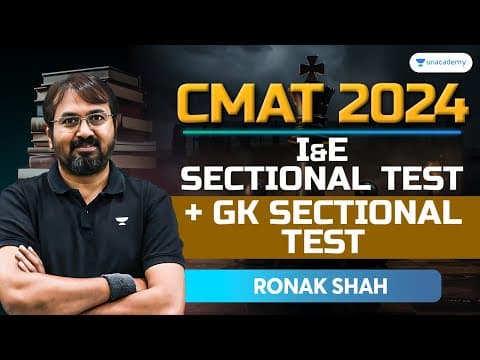
In this blog post, we will delve into the key points discussed during a sectional test session focused on innovation and entrepreneurship, as presented by Ronak Shah. The session aimed to prepare students for the CMAT 2024 examination by covering essential concepts and answering relevant questions.
The session began with a warm welcome to the participants, encouraging them to engage actively by confirming audio and video quality. The instructor emphasized the importance of participation and urged students to share their doubts in the comments section.
The first part of the session focused on innovation and entrepreneurship, highlighting the significance of these concepts in today’s business landscape. The instructor encouraged students to think critically about the questions posed, as their performance in this session would reflect their potential performance in the final exam.
The session discussed the role of angel investors and venture capital in promoting entrepreneurship. It was clarified that angel investors are individuals who provide capital for startups, often in exchange for convertible debt or ownership equity. The instructor pointed out a common misconception regarding venture capital firms, which are composed of multiple angel investors with diverse expertise.
A significant portion of the discussion revolved around the protection of intellectual property, particularly in the context of recipes and innovations. The instructor explained that a recipe could be patented if it meets certain criteria, such as being unique and involving an inventive step. The distinction between patents and trade secrets was also emphasized, highlighting the importance of protecting proprietary information.
The concept of globalization was introduced as the integration of domestic economies with the world economy. This was framed as a crucial aspect of modern entrepreneurship, where businesses must navigate international markets and competition.
The session outlined the stages of product development, including ideation, validation, and prototyping. The instructor stressed the importance of creating a prototype to test solutions against customer needs, which is a critical step in the entrepreneurial process.
Throughout the session, various questions were posed to the participants to test their understanding of the discussed concepts. Here are a few examples:
Question: Can a recipe be patented?
Answer: Yes, but it must be unique and involve an inventive step.
Question: What is the apex body in India for formulating policies regarding entrepreneurship development?
Answer: The National Entrepreneurship Development Board (NEDB).
Question: What is globalization?
Answer: The integration of domestic economies with the world economy.
The session concluded with a reminder for students to join the Telegram group for further discussions and updates. The instructor encouraged participants to practice more questions and stay engaged in their preparation for the CMAT 2024 examination.
Overall, the sectional test provided valuable insights into innovation and entrepreneurship, equipping students with the knowledge and skills necessary for success in their upcoming exams.