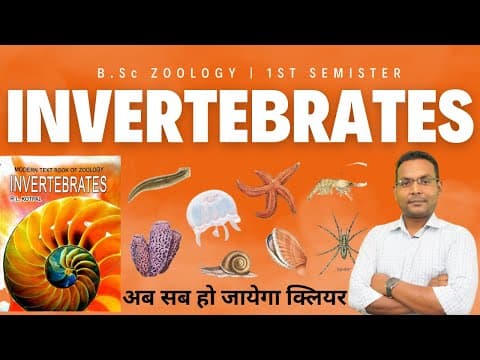
This blog post provides an in-depth overview of invertebrates, their definitions, classifications, diversity, and differences from vertebrates, as discussed in the B.Sc Zoology series by R.L. Kotpal.
Hello everyone! Welcome to the Young Men's Career Institute YouTube channel. Today, we are starting a new series on B.Sc Zoology, focusing on the fascinating world of invertebrates. Many students have requested this series to help them understand zoology better after completing their 12th grade. In this post, we will explore the topic of invertebrates based on R.L. Kotpal's book.
Invertebrates are organisms that lack a vertebral column, commonly known as a backbone. To understand this better, if you touch your back, you can feel the structure of your vertebral column, which protects your spinal cord. Invertebrates, by definition, do not possess this structure.
Invertebrates are defined as organisms that do not have a vertebral column. This broad definition allows us to include a wide variety of animals, regardless of their size, shape, or morphological characteristics. Essentially, any organism that lacks a backbone can be classified as an invertebrate.
A renowned scientist, Wilson, once stated that invertebrates are the little things that run the world. This is because invertebrates are numerous and diverse, playing a crucial role in maintaining the balance of our ecosystems. They influence both directly and indirectly the living systems around us. For instance, many small microorganisms help maintain the food chain and degrade organic matter, which is essential for ecosystem health.
Invertebrates encompass a vast category of organisms, with approximately 35 lakh species identified so far. They can be classified based on various criteria:
Invertebrates include a wide range of animals such as:
There is often confusion between the terms invertebrates and non-chordates. While many consider them synonymous, they are not the same. Non-chordates refer to organisms that lack a notochord, a rod-like structure that supports the body during development. In contrast, invertebrates are specifically those without a vertebral column. Thus, all invertebrates are non-chordates, but not all non-chordates are invertebrates.
Invertebrates exhibit immense diversity in various aspects:
Approximately 95% of all species on Earth are invertebrates, amounting to around 1.2 million species. This highlights their dominance in the animal kingdom.
Invertebrates can range from microscopic organisms, which require a microscope to be seen, to larger species like squids that can grow up to 16 meters in length.
Invertebrates can exhibit various shapes and types of symmetry:
Invertebrates also show diversity in their respiratory mechanisms. For example:
Different invertebrates have various excretory systems:
Invertebrates can reproduce sexually or asexually, with some capable of parthenogenesis, where organisms develop without fertilization.
To understand invertebrates better, it is helpful to compare them with vertebrates:
In conclusion, invertebrates are a diverse and essential group of organisms that play a vital role in our ecosystems. Understanding their characteristics, classifications, and differences from vertebrates is crucial for anyone studying zoology. If you have any questions or feedback about this series, please feel free to comment. Your input is valuable as we continue this educational journey together!