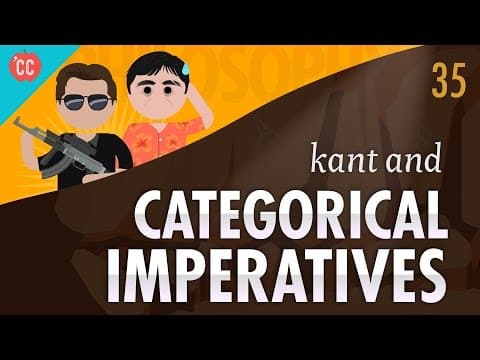
This blog post explores Immanuel Kant's ethical framework, focusing on his concepts of hypothetical and categorical imperatives, the universalizability principle, and the treatment of individuals as ends-in-themselves. It highlights the significance of reason in moral decision-making and contrasts Kantian ethics with other moral theories.
Immanuel Kant, an 18th-century German philosopher, revolutionized the field of ethics by proposing that morality is not derived from divine command or religious beliefs, but rather from reason and rationality. This blog post delves into Kant's ethical framework, particularly his concepts of hypothetical and categorical imperatives, and the implications of his moral philosophy.
Kant believed that morality should be independent of religion. He argued that if we rely on religious doctrines for our moral compass, we risk arriving at different conclusions based on varying beliefs. Instead, Kant posited that moral truths are universal and can be understood through reason alone. He distinguished between two types of imperatives that guide our actions:
Hypothetical imperatives are conditional commands that depend on our desires. For example, if you want to earn money, you ought to get a job. These imperatives are about prudence rather than morality; they are contingent on individual goals. If you do not desire money, then the imperative to work becomes optional.
In contrast, categorical imperatives are unconditional commands that apply to everyone, regardless of personal desires. Kant believed that these moral obligations are derived from pure reason and are binding on all rational beings. He emphasized that morality is not a matter of personal preference but a universal law that must be followed.
Kant articulated several formulations of the categorical imperative, with two being particularly significant:
The first formulation, known as the universalizability principle, states: "Act only according to that maxim which you can at the same time will that it should become a universal law without contradiction."
To unpack this, a maxim is a principle of action. Before acting, one should consider whether the underlying principle of their action could be universalized. For instance, if someone considers stealing a banana because they forgot their wallet, they must ask themselves if it would be acceptable for everyone to steal. If universalized, stealing would lead to a contradiction, as it would undermine the very concept of ownership. Thus, stealing cannot be morally justified.
The second formulation focuses on how we treat others: "Act so that you treat humanity, whether in your own person or in that of another, always as an end, and never as a mere means."
This principle emphasizes the inherent dignity of individuals. Using someone merely as a means to an end disregards their autonomy and rationality. For example, if one deceives another to gain a favor, they are treating that person as a mere tool for their own benefit, violating Kant's moral law. Instead, we must recognize the humanity and goals of others in our interactions.
Kant's ethical framework insists on the universality of moral laws and the importance of treating individuals with respect. However, it can lead to counterintuitive conclusions. For instance, in a scenario where a person must decide whether to lie to protect a friend from harm, Kant would argue that lying is never permissible, even if it could save a life. This strict adherence to moral law can seem harsh, but it underscores Kant's belief in the absolute nature of moral obligations.
Kant's philosophy presents a compelling argument for a rational basis of morality that transcends religious or subjective interpretations. By emphasizing the importance of reason, the universalizability of actions, and the intrinsic worth of individuals, Kantian ethics offers a robust framework for moral decision-making. While not without its challenges, Kant's categorical imperatives continue to influence contemporary discussions in moral philosophy, setting the stage for contrasting theories such as utilitarianism, which will be explored in future discussions.