This blog post explores the concepts of pairs and Church numerals in lambda calculus, detailing their construction, manipulation, and practical applications in programming. It emphasizes the importance of concise code and provides insights into implementing arithmetic operations using lambda calculus.
Lambda calculus is a foundational concept in computer science and mathematics, particularly in the study of functional programming. In this post, we will explore the encoding of pairs and Church numerals in lambda calculus, focusing on their construction, manipulation, and practical applications.
Recently, an assignment was released that focuses on implementing various reduction strategies in lambda calculus. The assignment tests the ability to implement normal order reduction and call-by-name and call-by-value reduction strategies. A key hint for students is that the amount of code they write should be minimal, ideally no more than three or four lines per function. If students find themselves writing more than ten lines, they should reconsider their approach.
In previous lectures, we discussed how to encode booleans in lambda calculus. Booleans are primitive data types, and we also explored functions that operate over booleans. In OCaml, we can construct pairs using primitive syntax, but in lambda calculus, we must represent pairs using functions.
A pair is simply a tuple with two components. In OCaml, we can create a pair using the syntax (1, 2). However, in lambda calculus, we represent a pair as a function that takes a boolean argument and applies it to the two components. The encoding of a pair can be defined as follows:
pair = λf. λs. λb. b f s
Here, f and s are the two components of the pair, and b is a boolean that determines which component to return.
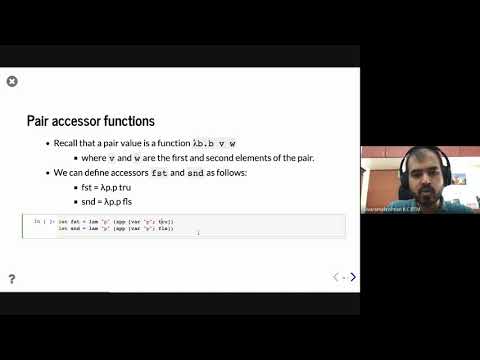
To access the components of a pair, we define two functions: first and second. These functions apply the boolean value to the pair:
first = λp. p true
second = λp. p false
When we evaluate these functions, they return the first or second component of the pair, respectively.
Beyond basic pair construction and access, we can implement additional functions such as a swap function, which exchanges the two components of a pair. The implementation of the swap function in lambda calculus can be expressed as:
swap = λp. second p, first p
This function takes a pair and returns a new pair with the components swapped.
In lambda calculus, we can also encode natural numbers using Church numerals. A Church numeral is a way of representing natural numbers as functions. For example, the numeral 0 can be represented as:
0 = λs. λz. z
And the numeral 1 can be represented as:
1 = λs. λz. s z
In general, a Church numeral n is defined as a function that takes two arguments: a successor function and a zero value. The numeral n applies the successor function n times to the zero value.
With Church numerals, we can implement basic arithmetic operations such as addition and multiplication. The addition of two Church numerals can be defined as:
plus = λm. λn. λs. λz. m s (n s z)
This function takes two Church numerals m and n and returns their sum.
Similarly, multiplication can be defined as:
multiply = λm. λn. λs. m (n s)
This function takes two Church numerals and returns their product.
The successor function can be easily implemented as:
succ = λn. λs. λz. s (n s z)
However, implementing the predecessor function is more complex. We can use pairs to represent a number and its predecessor together. The predecessor function can be defined using a pair that contains the number and its predecessor:
pred = λn. first (n (λp. pair (second p) (succ (second p))) (pair 0 0))
This function constructs a pair that represents the predecessor of a given Church numeral.
In this post, we explored the encoding of pairs and Church numerals in lambda calculus, detailing their construction and manipulation. We also discussed how to implement arithmetic operations using these encodings. Understanding these concepts is crucial for grasping the foundations of functional programming and the theoretical underpinnings of computation. By mastering these encodings, one can appreciate the elegance and power of lambda calculus in expressing complex ideas with simplicity.