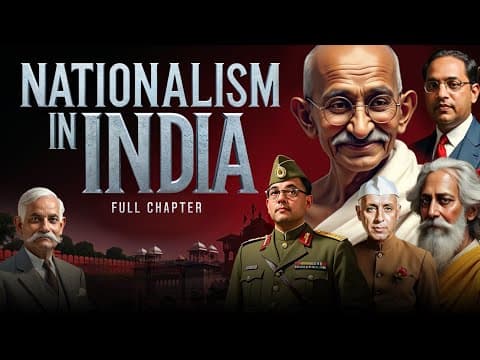
This blog post explores the key events and movements that shaped nationalism in India post-1915, including the impact of World War I, the role of Mahatma Gandhi, the Non-Cooperation Movement, and the Civil Disobedience Movement, highlighting the collective struggle for independence and the emergence of a national identity.
In this blog post, we will delve into Chapter 2 of Class 10 History, titled "Nationalism in India." This chapter examines the struggle for independence in India after 1915, the various movements that emerged, and how nationalism spread among the people, fostering a sense of love and patriotism for the country.
The chapter begins with the First World War, which started in 1914. Major powers were engaged in conflict, with Britain being a significant participant. Although India was not directly involved, the war had profound effects on the country due to British colonial rule.
These hardships led to the emergence of the idea of Satyagraha, a non-violent resistance against British oppression.
In January 1915, Mahatma Gandhi returned to India from South Africa, bringing with him the idea of Satyagraha, which emphasized non-violence and truth. Gandhi believed that struggles should be fought without weapons and through peaceful means.
Gandhi organized three significant Satyagraha movements:
These movements were successful, prompting the British government to respond with the repressive Rowlatt Act of 1919, which allowed for detention without trial.
In response to the Rowlatt Act, Gandhi launched a nationwide Satyagraha on April 6, 1919. This movement began with strikes and protests, leading to widespread unrest. The situation escalated when police fired on a peaceful procession in Amritsar on April 10, 1919, resulting in public outrage.
On April 13, 1919, during the Baisakhi festival, General Dyer ordered troops to fire on a gathering at Jallianwala Bagh, killing hundreds. This incident shocked the nation and led to violent protests across North India, prompting Gandhi to call off the Satyagraha.
Recognizing the need for a broader movement, Gandhi sought to unite Hindus and Muslims. The Khilafat Movement, aimed at defending the Ottoman Caliphate, provided an opportunity for collaboration.
In September 1920, Gandhi proposed the Non-Cooperation Movement at a Congress session in Kolkata. The movement aimed to boycott British institutions and promote self-reliance.
In urban areas, the middle class actively participated, with students leaving government schools and lawyers boycotting courts. However, the movement faced challenges as the appeal of foreign goods remained strong due to their lower prices.
In rural areas, the movement took on different forms:
The movement faced a turning point with the Chauri Chaura incident in February 1922, where a violent clash resulted in the deaths of police officers. This prompted Gandhi to call off the Non-Cooperation Movement.
Following the Non-Cooperation Movement, Gandhi recognized the need for proper training and unity among the masses before launching another struggle. The Civil Disobedience Movement began with the Salt March in 1930.
Gandhi chose salt as a symbol of resistance against British laws. On March 12, 1930, he began a 240-mile march to Dandi, where he illegally produced salt, marking the start of the Civil Disobedience Movement.
The movement saw widespread participation, with people breaking salt laws and boycotting foreign goods. However, the British responded with arrests and violence, leading to Gandhi's eventual arrest.
Rich peasants, particularly in Gujarat and UP, participated actively, seeking relief from high taxes during the economic depression.
Poor peasants, lacking land, sought rent reductions but faced neglect from the Congress, which aimed to maintain support from wealthy landlords.
Indian businessmen, facing restrictive colonial policies, supported the movement financially and boycotted foreign goods.
Industrial workers participated minimally, focusing on improving wages and working conditions, but were largely ignored by the Congress.
Women played a significant role, participating in protests and marches, although their contributions were often overlooked.
Not all groups participated equally. Dalits and Muslims had limited involvement due to neglect from the Congress and rising communal tensions.
Gandhi supported Dalit rights, but the Congress largely ignored their demands, leading to the formation of separate electoral associations.
Muslim participation waned due to growing tensions and the formation of separate organizations, leading to a lack of unity in the struggle.
The struggle for independence fostered a sense of collective belonging among Indians, driven by shared goals and cultural connections. The efforts of leaders like Gandhi, along with cultural movements and symbols, helped unite diverse groups in the fight against colonial rule, ultimately leading to India's independence.