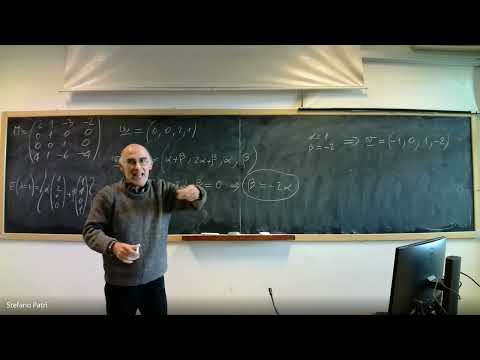
Understanding Orthogonal Complements in Linear Algebra: A Step-by-Step Guide
This blog post explores the concept of orthogonal complements in linear algebra, detailing the process of finding them through vector operations and scalar products, and providing examples to illustrate the principles involved.
Linear algebra is a fundamental area of mathematics that deals with vectors, vector spaces, and linear transformations. One of the key concepts in this field is the idea of orthogonal complements. This blog post will guide you through the process of finding orthogonal complements, using vector operations and scalar products.
An orthogonal complement of a subspace is the set of all vectors that are orthogonal to every vector in that subspace. If we have a subspace V, the orthogonal complement is denoted as V⊥. Understanding this concept is crucial for solving various problems in linear algebra, especially in higher-dimensional spaces.
Finding the Orthogonal Complement
To find the orthogonal complement of a subspace, we need to follow a systematic approach:
-
Identify the Basis Vectors: Start by identifying the basis vectors of the subspace. For example, if we have vectors v1 and v2, we will use these to find the orthogonal complement.
-
Set Up the Scalar Product Conditions: A vector u is in the orthogonal complement if it satisfies the following conditions:
- The scalar product of u with v1 equals zero.
- The scalar product of u with v2 equals zero.
This can be expressed mathematically as:
[ u \cdot v1 = 0 ] [ u \cdot v2 = 0 ]
-
Formulate the System of Equations: From the scalar product conditions, we can derive a system of equations. For instance, if u is represented as ( (x1, x2, x3, x4) ), we can set up equations based on the coefficients of the basis vectors.
-
Solve the System: Solve the system of equations to find the values of the components of u. This will give us the vectors that form the orthogonal complement.
Example of Finding an Orthogonal Complement
Let’s consider a simple example where we have two basis vectors:
- v1 = (1, 0, 1, -1)
- v2 = (0, 1, 1, 0)
We want to find a vector u = (x1, x2, x3, x4) such that:
- ( u \cdot v1 = x1 + 0 + x3 - x4 = 0 )
- ( u \cdot v2 = 0 + x2 + x3 + 0 = 0 )
This leads us to the following equations:
- ( x1 + x3 - x4 = 0 )