This blog post explores the concepts of parametric integration and differentiation through a detailed mathematics exam question, covering the calculation of coordinates, tangent lines, and the area under curves.
In this blog post, we will delve into the concepts of parametric integration and differentiation, illustrated through a mathematics exam question involving a curve defined by parametric equations. We will explore how to find coordinates, derive tangent lines, and calculate areas under curves.
The curve C is defined by the following parametric equations:
where T is constrained to the interval (-2, 4). We will analyze the point P on the curve where T = 3.
To find the coordinates of point P, we substitute T = 3 into the parametric equations:
For x:
x = 3³ + 3(3) = 27 + 9 = 36
For y:
y = 3(3²) = 3(9) = 27
Thus, the coordinates of point P are (36, 27).
The tangent line L at point P can be determined using calculus. The gradient of the tangent line at point P is equal to the gradient of the curve at that point. We will differentiate the parametric equations to find the gradient function:
The formula for the gradient ( \frac{dy}{dx} ) is given by:
[ \frac{dy}{dx} = \frac{\frac{dy}{dt}}{\frac{dx}{dt}} ]
Calculating the derivatives:
Substituting T = 3 into the gradient function:
[ \frac{dy}{dx} \bigg|_{T=3} = \frac{6(3)}{3(3)² + 3} = \frac{18}{30} = \frac{3}{5} ]
Now, using the point-slope form of the line equation:
[ y - y_1 = m(x - x_1) ]
Substituting the values:
This gives: [ y - 27 = \frac{3}{5}(x - 36) ]
Expanding and rearranging leads to: [ 3x - 5y + 27 = 0 ]
The line L intersects the curve C again at point Q. To find the coordinates of Q, we need to solve the following equations simultaneously:
The parametric equations:
The line equation:
Substituting the parametric equations into the line equation:
[ 3(T³ + 3T) - 5(3T²) + 27 = 0 ]
Expanding this gives: [ 3T³ + 9T - 15T² + 27 = 0 ]
Rearranging leads to: [ 3T³ - 15T² + 36 = 0 ]
Solving this cubic equation yields T = -1 and T = 3. Since T = 3 corresponds to point P, we substitute T = -1 to find the coordinates of Q:
For x:
x = (-1)³ + 3(-1) = -1 - 3 = -4
For y:
y = 3(-1)² = 3(1) = 3
Thus, the coordinates of point Q are (-4, 3).
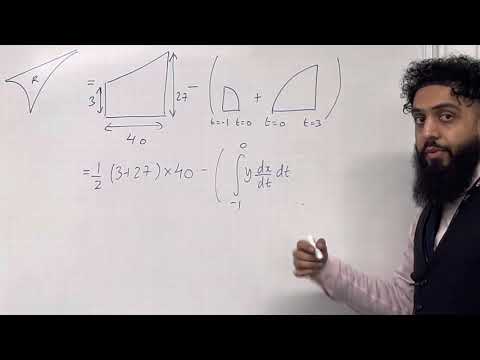
The finite region R is bounded by the curve C and the line L. To find the area of R, we will calculate the area of the trapezium formed by points P and Q and subtract the area under the curve.
The area of the trapezium can be calculated using the formula: [ \text{Area} = \frac{1}{2} \times (b_1 + b_2) \times h ]
Where:
Thus, the area of the trapezium is: [ \text{Area} = \frac{1}{2} \times (27 + 3) \times 40 = 600 ]
To find the area under the curve, we will integrate the function from T = -1 to T = 3: [ \text{Area} = \int_{-1}^{3} y \frac{dx}{dt} dt ]
Substituting the values: [ y = 3T² \quad \text{and} \quad \frac{dx}{dt} = 3T² + 3 ]
This leads to: [ \int_{-1}^{3} 3T²(3T² + 3) dt ]
After performing the integration and substituting the limits, we find: [ 600 - \text{Area under the curve} = \frac{384}{5} \text{ unit squared} ]
Thus, the exact area of region R is: [ \frac{384}{5} \text{ unit squared} ]
In this post, we explored the concepts of parametric integration and differentiation through a detailed example. We calculated coordinates, derived the equation of a tangent line, and found the area under a curve, demonstrating the application of calculus in solving complex mathematical problems. Understanding these concepts is crucial for anyone studying mathematics, particularly in fields that require analytical skills and problem-solving abilities.