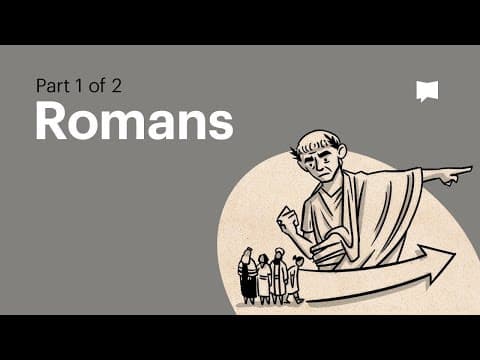
Paul's letter to the Romans addresses the division within the church, emphasizing the need for unity among Jewish and non-Jewish followers of Jesus. He explores themes of sin, righteousness, justification, and the implications of faith, ultimately presenting the gospel as God's solution for humanity's brokenness.
Paul's letter to the Romans is one of the longest and most significant writings attributed to him, who was formerly known as Saul of Tarsus. A Jewish rabbi and a member of the Pharisees, Paul was initially a staunch defender of the Torah and viewed Jesus and His followers as a threat. However, after a transformative encounter with the risen Jesus, he became an apostle, tasked with spreading the message of Jesus to the Gentiles, or non-Jewish people. This marked the beginning of his mission, during which he traveled throughout the ancient Roman Empire, establishing communities of believers known as churches.
The Book of Romans was written later in Paul's ministry, addressing a church in Rome that had been experiencing significant tension. This church was composed of both Jewish and non-Jewish followers of Jesus. A pivotal moment occurred when the Roman Emperor Claudius expelled all Jewish people from Rome, including Jewish Christians. After five years, they were allowed to return, only to find a church that had adopted predominantly non-Jewish customs and practices. This shift led to disagreements about how to follow Jesus, including debates over the observance of the Sabbath, dietary laws, and circumcision.
Paul's primary objectives in writing this letter were to unify the divided church and to prepare them for his mission to expand further west to Spain. To achieve this, he provides a thorough explanation of the gospel—the good news of Jesus's life, death, and resurrection.
The letter is structured into four main movements, but it flows as a cohesive exploration of the gospel. In the first four chapters, Paul emphasizes two key themes: the revelation of God's righteousness and the creation of a new humanity that fulfills God's promises to Israel. These themes are crucial for understanding how the gospel can unify the church.
Paul begins by introducing himself as an apostle appointed by God to spread the gospel about Jesus, whom he identifies as the Messiah of Israel and the King of the nations. He asserts that this good news is both God's power to save those who trust in Him and a revelation of God's righteousness.
Righteousness, a term rich in Old Testament significance, describes God's character as just and faithful. Paul argues that the story of Jesus exemplifies how God fulfills His promises and executes justice.
In a creative retelling of Genesis chapters 3 through 11, Paul illustrates how all of humanity, particularly the Gentiles, has become ensnared in a cycle of sin and selfishness. He describes the human heart and mind as broken, having turned away from God to embrace idolatry—placing ultimate significance on created things rather than on God Himself. This idolatry leads to a distortion of humanity and destructive behaviors, leaving all people guilty before a just and righteous God.
The people of Israel might argue that their selection by God and the laws of the Torah, including the Sabbath and dietary restrictions, set them apart as His holy people. However, Paul counters this notion by recalling the broader narrative of the Torah and the Old Testament, which reveals that Israel is just as sinful and idolatrous as the Gentiles. In fact, he claims that Israel bears greater guilt because they had the Torah and should have known better.
Despite this grim assessment of humanity's condition, Paul presents the good news about Jesus as God's response to humanity's plight. Rather than condemning humanity, Jesus, as Israel's Messiah, came to die for all people, taking upon Himself the consequences of sin and death. His resurrection signifies victory over these forces, offering new life to all who believe.
Paul introduces the concept of justification, a term that signifies being declared righteous. Through Jesus's sacrificial act, those who trust in Him are granted a new status before God, moving from guilt to forgiveness. This justification leads to a new family, as believers are incorporated into God's covenant people, and it initiates a transformative journey of life through God's grace.
In chapter 4, Paul explores the implications of justification for inclusion in God's covenant family by referencing Abraham's story from Genesis 15. Before the laws of the Torah were established, Abraham was declared righteous due to his faith in God's promise to make him the father of a large, multi-ethnic family. Paul argues that Abraham serves as the father of this new covenant family, which now includes both Jews and Gentiles who share the same faith in Jesus.
To summarize Paul's main ideas in chapters 1 through 4:
As Paul continues in his letter, he will elaborate on how this new family is part of a much larger narrative, calling them to a new way of life together, rooted in the foundational ideas presented in these initial chapters.