This blog post explores the fundamental concepts of the chain rule and product rule in calculus, providing intuitive explanations and visualizations to help understand how to derive complex functions from simpler ones. It emphasizes the importance of grasping these concepts rather than merely memorizing formulas.
In previous discussions, we focused on the derivatives of simple functions, aiming to build a clear intuition about the origins of these formulas. However, most functions encountered in real-world modeling involve combinations of these simpler functions. Therefore, our next step is to delve into how to derive more complex combinations of functions. The goal is to foster a deep understanding rather than rote memorization.
When combining functions, there are three primary methods:
While subtraction can be viewed as adding a negative function and division can be seen as multiplying by the reciprocal, these operations do not introduce new concepts. Thus, understanding derivatives in the context of addition, multiplication, and composition is crucial for tackling more complex expressions.
The sum rule is the simplest of the three rules. It states that the derivative of a sum of two functions is the sum of their derivatives. To illustrate this, consider the function:
At any given input, this function adds the values of sin(x) and x². For instance, at x = 0.5, the heights of the sine graph and the parabola are combined. To find the derivative, we examine how the function changes when nudging the input slightly (x + dx).
The change in the function, denoted as df, can be expressed as:
Thus, the total change in height is:
df = d(sin(x)) + d(x²) = cos(x) * dx + 2x * dx
Dividing by dx gives:
df/dx = cos(x) + 2x
This confirms that the derivative of the sum is indeed the sum of the derivatives.
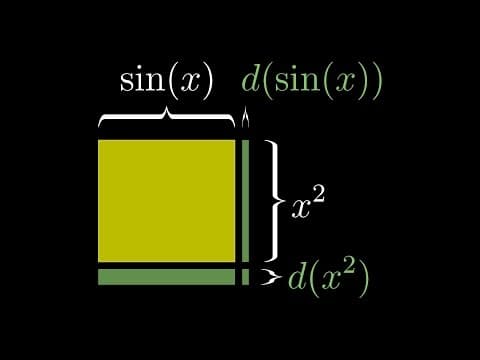
The product rule is more complex. To understand it, we can visualize the product of two functions as the area of a rectangle where the sides are defined by these functions. For example, consider:
Here, the area of the rectangle changes as x changes. When nudging x by dx, the area change df can be broken down into three components:
Using the derivatives:
The total change in area becomes:
df = sin(x) * (2x * dx) + x² * (cos(x) * dx)
Dividing by dx gives:
df/dx = sin(x) * 2x + x² * cos(x)
This can be remembered with the mnemonic: "Left d right, right d left," indicating the order of operations in the product rule.
The chain rule is essential for understanding function composition. For instance, if we take:
To find the derivative, we can visualize this with three number lines:
When nudging x by dx, the changes propagate through the layers:
Thus, the derivative can be expressed as:
dg/dx = (dg/dh) * (dh/dx) = cos(x²) * (2x * dx)
This leads to the general formula for the chain rule:
dg/dx = g'(h) * h'(x)
In summary, the three fundamental rules for derivatives—sum rule, product rule, and chain rule—are essential tools for handling complex functions. Understanding these concepts deeply is crucial for applying them effectively in various mathematical contexts. While knowing the rules is important, practicing their application is vital for developing fluency in calculus. The insights shared here aim to provide a foundation for this understanding, encouraging a thoughtful approach to derivatives rather than mere memorization.