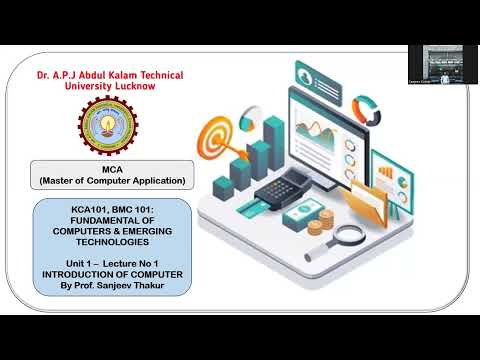
In this blog post, we will explore the fundamentals of computers and emerging technologies, particularly focusing on the syllabus for the MCA program. We will cover the definitions, functions, generations, and components of computers, providing a thorough understanding for students and enthusiasts alike.
What is a Computer?
A computer is an electronic device capable of receiving, processing, and storing data to produce meaningful information. It performs arithmetic operations such as addition, subtraction, multiplication, division, and logical comparisons with high speed and accuracy. If the input is incorrect, the output will also be incorrect, emphasizing the importance of accurate data entry.
Definitions of a Computer
- Definition 1: A computer is an electronic device capable of receiving, processing, and storing data to produce meaningful information. It performs operations like arithmetic calculations and logical comparisons at high speed and accuracy.
- Definition 2: A computer is an electronic device that performs a variety of tasks by following a set of instructions (programs). It processes data, stores it, and executes commands across various applications.
Functions of a Computer
Computers perform four main functions:
- Input: Receiving data from external resources through input devices.
- Processing: Performing calculations and logical operations using the CPU.
- Output: Displaying the processed information through output devices.
- Storage: Saving data temporarily or permanently for future use.
Generations of Computers
The evolution of computers can be categorized into five generations, each marked by significant technological advancements:
First Generation (1942-1956)
- Technology: Vacuum tubes and magnetic drums.
- Characteristics: Large size, slow processing speed, and used punch cards for input.
Second Generation (1956-1963)
- Technology: Transistors replaced vacuum tubes.
- Characteristics: Smaller size, improved speed, and introduced programming languages like FORTRAN and COBOL.
Third Generation (1964-1971)
- Technology: Integrated circuits replaced transistors.
- Characteristics: Further miniaturization, faster processing, and the introduction of operating systems.
Fourth Generation (1971-Present)
- Technology: Microprocessors.
- Characteristics: Personal computers, graphical user interfaces, and high-level programming languages like C, C++, Java, and Python.
Fifth Generation (Present and Beyond)
- Technology: Artificial Intelligence, quantum computing, and nanotechnology.
- Characteristics: Focus on AI applications, deep learning, and machine learning.
Components of a Computer System
Computers consist of two main components: hardware and software.
Hardware
Hardware refers to the physical components of a computer that can be seen and touched. Key hardware components include:
- Input Devices: Keyboard, mouse, scanner, etc.
- Output Devices: Monitor, printer, speakers, etc.
- Central Processing Unit (CPU): The brain of the computer that performs calculations and processes instructions.
- Memory: Includes primary memory (RAM) for temporary storage and secondary memory (hard drives, SSDs) for permanent storage.
Software
Software refers to the programs and applications that run on a computer, enabling it to perform specific tasks.
Conclusion
Understanding the fundamentals of computers and emerging technologies is essential for students pursuing a career in computer science. This overview provides a solid foundation for further exploration into the vast field of computing, highlighting the importance of both hardware and software in the functioning of modern computers. As technology continues to evolve, staying informed about these fundamentals will be crucial for success in the industry.