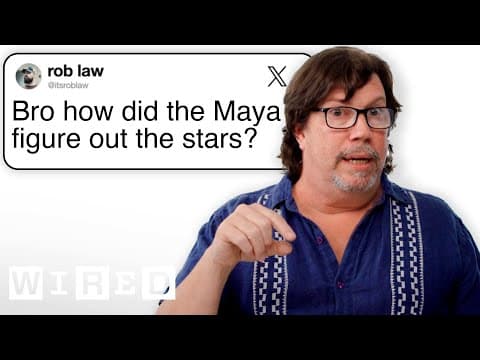
Dr. Ed Barnhart answers popular questions about the Maya civilization, covering topics such as their unique customs, calendar systems, sports, and the enduring legacy of the Maya people today.
Dr. Ed Barnhart, an expert on the Maya civilization, addresses various questions from the internet in this engaging session. Here, we delve into the fascinating aspects of the Maya culture, their practices, and their lasting impact on the world.
One of the intriguing customs of the Maya was the practice of tying boards to babies' heads to shape their skulls. This practice aimed to elongate the skull, making it resemble a husk of corn, which was significant to the Maya as they were known as corn people. Only elite families were permitted to engage in this practice, as a pointed head was a symbol of high status. Dr. Barnhart humorously speculates that some peasant families might have secretly attempted this to elevate their children's status.
Responding to a question about the portrayal of Kukulkan, a Mayan deity, in the film "Black Panther," Dr. Barnhart explains that Kukulkan, also known as Quetzalcoatl, embodies not just power but wisdom and good governance. He reassures that the character's representation resonated well with real Maya people, highlighting the importance of cultural representation in media.
A common misconception is that the calendar resembling an OREO is Mayan; however, Dr. Barnhart clarifies that it is actually the Aztec calendar stone. The Maya had a complex calendar system, including a 260-day calendar that corresponds to the human gestation period. This unique cycle reflects the Maya's deep connection to time and their environment.
When asked about the first clothing trends, Dr. Barnhart notes that the Maya had a distinct sense of style, evidenced by their intricate sandals and garments depicted in ceramic art. Their fashion included tunics and decorative elements, showcasing their artistic flair.
Addressing the widespread belief that the world would end in 2012, Dr. Barnhart explains that this date marked the end of a cycle in the Mayan calendar, not an apocalypse. The Maya anticipated a new beginning rather than an end, with the next significant date being 4,772.
Dr. Barnhart highlights the differences between the Maya and Aztecs, noting that while the Aztecs were an empire focused on conquest and sacrifice, the Maya operated as independent city-states with less emphasis on warfare. The Maya practiced auto-sacrifice, where kings would perform bloodletting as a form of devotion.
The Maya enjoyed a sport known as the Maya ball game, or pok-a-tok, which involved bouncing a rubber ball off a sloping wall without using hands or feet. This game was not only a form of entertainment but also served as a means to resolve conflicts between cities, with significant crowds and rewards for the winning teams.
When discussing sacrifices, Dr. Barnhart clarifies that the Maya primarily sacrificed captured warriors during ceremonial battles, contrasting with the Aztecs, who sacrificed a broader range of individuals.
Dr. Barnhart recounts a story of a young boy who believed he found a lost Maya city, emphasizing the potential for discovering ancient sites with modern technology like lidar. He shares his own experience of finding a city in Belize, demonstrating the ongoing exploration of Maya heritage.
Cacao beans were used as a form of currency among the Maya, and Dr. Barnhart explains how they were integral to their economy. The beans were valued for their portability and were often used in trade, with chocolate being a drink of the elite.
The Maya civilization dates back approximately 10,000 years, with the classic period beginning around 200 CE. This era saw the rise of significant cities like Tikal, which flourished for about 400 years before entering a transitional phase.
When comparing Mayan and Egyptian pyramids, Dr. Barnhart notes that while the Great Pyramid of Giza is the tallest, the Maya built thousands of pyramids, many of which remain undiscovered beneath the jungle. Unlike the Egyptians, who built pyramids as tombs, the Maya used them as temples during their lifetimes.
The Maya were not a metal-using culture; instead, they crafted tools from chert and obsidian. These materials allowed them to construct their impressive architectural feats without the use of metal tools.
Dr. Barnhart dismisses the notion that aliens assisted the Maya in their achievements, asserting that their accomplishments were the result of human ingenuity and skill.
King Pakal's sarcophagus lid has sparked theories of ancient astronauts, but Dr. Barnhart interprets it as a representation of Pakal's journey to the underworld, emphasizing the rich symbolism in Maya art.
Dr. Barnhart shares his admiration for the ruins of Palenque, where he spent years mapping the site. He highlights the architectural innovations and the city's historical significance in Maya culture.
The Maya developed a unique writing system that reflected their spoken language, distinguishing them from other indigenous cultures in the Americas. Their glyphs conveyed complex ideas and were used for various purposes, including recording important events.
Dr. Barnhart provides insight into the Yucatec Maya language, still spoken by millions today. He notes that while some portrayals in media may exaggerate certain aspects of Maya culture, the language remains a vital part of their identity.
The Maya engineered their cities to thrive in challenging environments, utilizing quarries as reservoirs and designing plazas to funnel rainwater into storage. This ingenuity allowed them to sustain large populations despite geographical limitations.
The Maya were skilled astronomers, observing celestial cycles and aligning their structures with astronomical events. Their knowledge of the stars was foundational to their culture and practices.
The Maya developed a sophisticated mathematical system using only three symbols, including the concept of zero. Their approach to mathematics was more elegant than many contemporary systems.
Contrary to popular belief, the Maya civilization did not vanish. Today, approximately 15 million Maya people continue to thrive, maintaining their cultural heritage despite historical challenges.
In conclusion, Dr. Ed Barnhart's insights provide a deeper understanding of the Maya civilization, dispelling myths and celebrating their rich history and ongoing legacy. The Maya are not just a part of history; they are a living culture that continues to influence the world today.