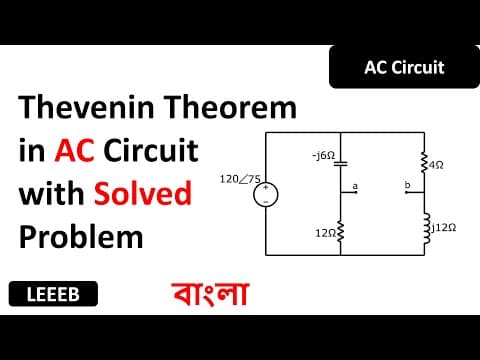
This blog post explores Thevenin's Theorem in AC circuits, detailing its significance, applications, and a solved problem to illustrate its practical use.
Thevenin's Theorem is a fundamental principle in electrical engineering that simplifies the analysis of complex circuits. This blog post will delve into the details of Thevenin's Theorem as applied to AC circuits, its significance, and a practical example to illustrate its application.
Thevenin's Theorem states that any linear electrical network with voltage sources and resistances can be replaced by an equivalent circuit consisting of a single voltage source (Thevenin voltage) in series with a single resistance (Thevenin resistance). This theorem is particularly useful for simplifying the analysis of circuits, especially when dealing with multiple components.
In AC circuits, Thevenin's Theorem helps engineers and technicians analyze circuits more efficiently. It allows for the simplification of complex networks into manageable forms, making it easier to calculate current and voltage across specific components. This is crucial in designing and troubleshooting electrical systems.
To illustrate the application of Thevenin's Theorem, let’s consider a simple AC circuit example:
Remove RL from the circuit to analyze the remaining circuit.
To find Vth, calculate the voltage across R2:
To find Rth, turn off the AC source:
Now, reattach the load resistor (RL = 8Ω) to the Thevenin equivalent circuit:
Using Ohm's Law, the total resistance in the circuit is Rth + RL = 10Ω + 8Ω = 18Ω. The total current (I_total) flowing through the circuit is:
The voltage across the load resistor (RL) can be calculated as:
Thevenin's Theorem is a powerful tool in the analysis of AC circuits, allowing for simplification and easier calculations. By following the steps outlined above, engineers can effectively apply this theorem to various circuit configurations, enhancing their understanding and efficiency in circuit design and troubleshooting. Understanding Thevenin's Theorem is essential for anyone working in the field of electrical engineering, as it lays the groundwork for more complex circuit analysis techniques.