Editorial Team
7 min read
OpenAI reports up to 14% improvement in AMD GPU design metrics, with some circuit changes sent for manufacturing. The results show progress on production designs, but leave whole-chip performance gains and the economics of AI-assisted engineering undisclosed.
OpenAI, the AI model developer, says its models delivered roughly a year's worth of additional chip-design progress for processor designer AMD in less than five months. In its November 18 technical account, the company reports up to 14% improvement in power, performance and area, or PPA, relative to heavily optimized baselines for AMD's flagship graphics-processor intellectual property.
The consequential detail is adoption: OpenAI says AMD has included some proposed changes in a design sent for manufacturing and placed others in production design files for future versions. That puts the work beyond a benchmark exercise. It does not establish a 14% speedup for an entire GPU, equal improvements in all three PPA measures, or a corresponding reduction in the cost of running AI.
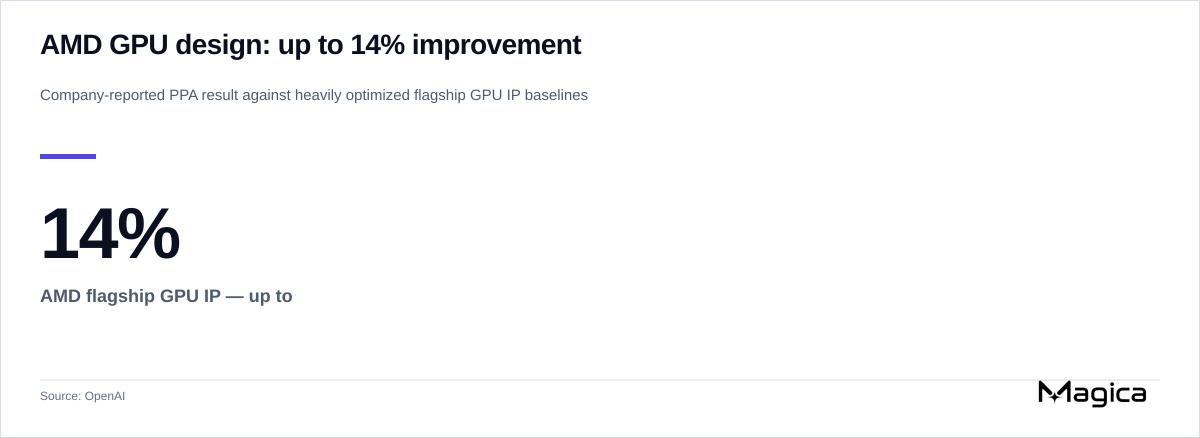
Company-reported: OpenAI reports up to 14% improvement against optimized AMD GPU IP baselines; this does not establish a 14% whole-GPU speedup. Chart: Magica. Source: OpenAI.
OpenAI said in its results post that AMD engineers had already spent years optimizing the GPU designs. The models then rewrote SystemVerilog register-transfer-level code, the hardware description that specifies circuit behavior. They used tools from Synopsys, a supplier of electronic design automation software, to check that each rewrite preserved a block's behavior and to evaluate trade-offs among power consumption, speed and circuit area.
OpenAI says AMD also verified single-digit percentage PPA gains across key blocks of its upcoming flagship CPU. The account does not identify the GPU or CPU product, provide a block-by-block breakdown of the 14% maximum, or publish the costs of model use, tool runs and engineering review. Its comparison with a year of progress is therefore a company estimate whose basis readers cannot fully reconstruct from the disclosure.
There is a useful distinction between the two production examples. For AMD, OpenAI describes changes accepted into designs, including one sent for manufacturing. For Jalapeño, OpenAI's first custom chip for inference—the process of running a trained AI model—it reports improvements verified in actual silicon.
OpenAI began using GPT-4o on Jalapeño in early 2025. It estimates that model-proposed changes reduced standard-cell area by about 13% in the vector unit and 10% in the matrix unit. Those are component-area savings, not reductions in the size of the entire chip. One matrix-unit multiplier redesign used about 15% less cell area in synthesis while cutting latency from two clock cycles to one, illustrating how the models changed circuit organization rather than merely suggesting edits to engineers.
A report on the results says Jalapeño went from design to manufacturing in nine months—a separate timeline from the AMD optimization effort. It also notes that Richard Ho, OpenAI's chip chief, said in October that he still did not fully trust AI design changes; it says every change is checked. Accepted model output still depends on engineering validation.
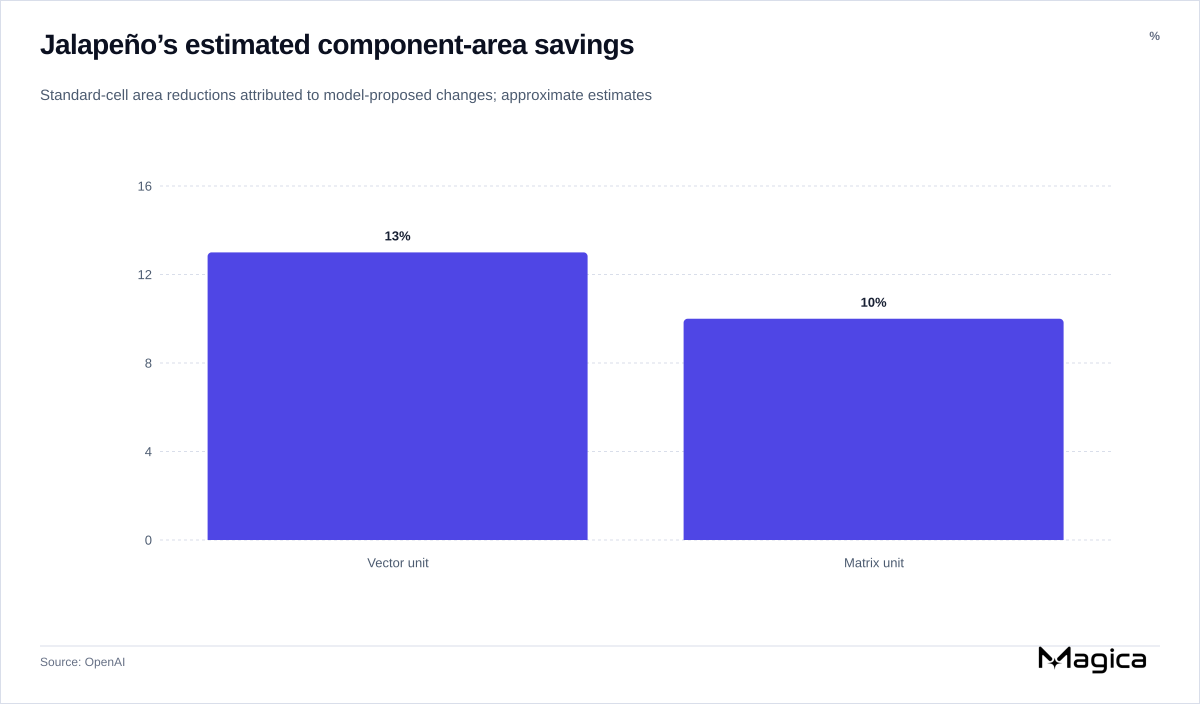
Company-reported: OpenAI estimates about 13% and 10% standard-cell area savings in Jalapeño’s vector and matrix units, respectively. These are component savings. Chart: Magica. Source: OpenAI.
AMD's involvement follows an established hardware and software relationship with OpenAI. An October 2025 partnership announcement filed with securities regulators set out an agreement to deploy six gigawatts of AMD GPUs across multiple generations, extending collaboration that began with MI300X and continued with MI350X.
The announcement scheduled the first one-gigawatt deployment, using AMD Instinct MI450-series GPUs, to begin in the second half of 2026. AMD projected tens of billions of dollars in revenue from the partnership; that was an expectation, not revenue already earned. The filing also identifies reliance on third-party manufacturing, component availability and manufacturing yields as risks. Faster circuit optimization alone does not resolve those constraints.
The agreement also gave OpenAI a warrant for up to 160 million AMD shares. Vesting depends on deployment, purchase, share-price and technical and commercial milestones. The six-gigawatt figure describes the agreement's planned scale, not evidence that this capacity has been installed.
OpenAI consequently has a commercial stake in AMD's success as well as an interest in improving the hardware available for its own computing needs. Its design claims should be read as a partner's account of joint work. AMD verification described by OpenAI is meaningful, but the disclosure does not supply an independently reproducible production benchmark.
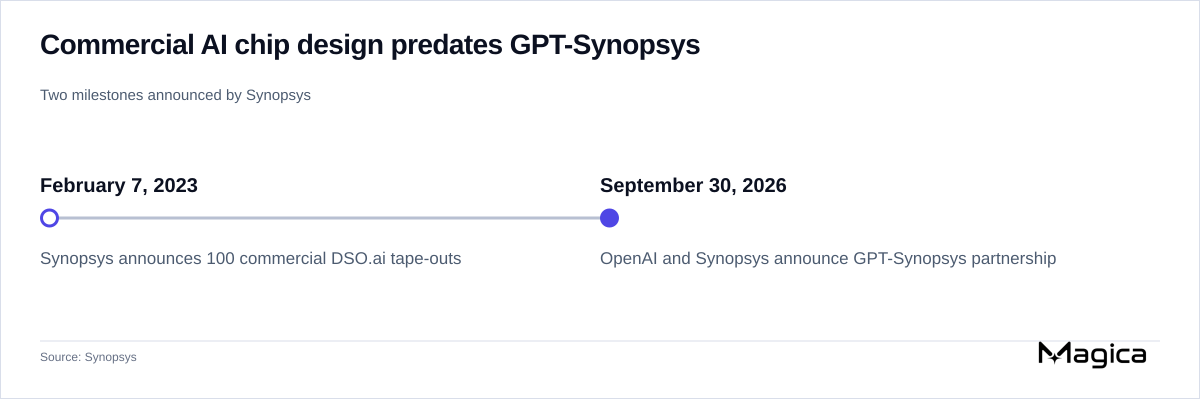
Company-reported milestones: Synopsys announced 100 commercial DSO.ai tape-outs in 2023 and its GPT-Synopsys partnership with OpenAI in 2026. Chart: Magica. Source: Synopsys commercial design results.
In February 2023, Synopsys announced 100 commercial tape-outs using its DSO.ai system, which applies reinforcement learning to design optimization. A tape-out is the handoff of a completed design for manufacturing. That precedent narrows the novelty here: the new evidence concerns general-purpose models rewriting circuit descriptions on already optimized production designs, rather than the first use of AI in chip engineering.
The same Synopsys announcement included customer accounts of more than threefold improvement in PPA exploration productivity at STMicroelectronics and a 5% die shrink at SK hynix. Those measures concern different workflows and designs and cannot be ranked against OpenAI's 14% maximum. They show that commercial AI design gains predate this work.
Other companies are pursuing related opportunities. A report on the results notes that Architect Labs, a startup seeking to help companies design custom chips with AI, raised $24 million in June. Funding establishes a competing effort, not equivalent production results.
AI can also improve hardware deployment without redesigning circuits. A parallel account relays AI developer Anthropic's claim that its Mythos model handled prompt processing for a model on AMD MI355X GPUs in three days, versus the six to twelve months it says the task usually takes. That is a software-porting claim, with its own company-provided baseline, rather than corroboration of OpenAI's PPA results.
To compare model generations, OpenAI ran 9,881 scored evaluations across two tasks, two open-source 32-bit RISC-V processor cores and multiple token budgets. PicoRV32 is a compact core designed for field-programmable gate arrays; Ibex is the embedded processor used in OpenTitan's security chip. These are small embedded processors, not substitutes for AMD's flagship GPU.
Models either optimized existing hardware descriptions or built cores from written requirements. OpenAI checked simulation outputs and assigned zero to designs that failed checks or exceeded 16 times the original core's area. For passing designs, it combined the geometric mean of instructions per clock cycle on hidden workloads with a maximum clock frequency estimated using Yosys, a synthesis tool. Scores were normalized separately for each core, with the best observed throughput under the constraints assigned 1.0; averages included failed runs.
At comparable budgets of about 112,000 tokens per run, GPT-6.2 Astra had the highest average score on both existing cores, and GPT-6.1 Sol outperformed GPT-5.6 Sol. All five tested models scored better when building from requirements than when optimizing existing code.
That last result has a substantial qualification. Models could omit features present in the original cores, including performance counters and additional instructions, that may contribute little to throughput on the measured workloads. OpenAI itself says tighter area limits, required feature retention and timing checks after physical synthesis would make the evaluation more representative of production design. A higher score under these rules is evidence of progress on the test, not a measured commercial-chip performance gain.
OpenAI is training GPT-Synopsys to use the design tools as expert engineers do. A September 30 joint announcement already established a multi-year preferred partnership, licensing of Synopsys tools and a shared-revenue arrangement for bringing the specialized model to customers. Synopsys is therefore both part of the validation infrastructure and a commercial partner in selling the approach.
The partners said GPT-Synopsys would run on OpenAI-hosted infrastructure, integrate with Synopsys' existing AI platforms and bundle computing, the model and tool licenses in a joint service. They described early customer engagements and promised that customer design data would not be used for model training. Engineers would review the agents' results. The announcement does not disclose prices.
The next useful evidence would connect accepted circuit changes to finished AMD silicon, specify how gains are distributed across blocks and PPA measures, and disclose the computing and human effort required. Without those inputs, a shorter optimization interval cannot establish lower total design costs. The remaining question is how reliably and economically those gains can be repeated.
A 2,000-cubic-metre tank and mobile pumping capacity address northern Hong Kong flooding, while AI tools help position crews and detect rising water. Official records distinguish established monitoring from three-site forecasting trials, with costs disclosed but comparative performance results absent.
Reported server price demands reach 45% above earlier agreements. HPE explicitly permits repricing before shipment, while XTX's disputed Dell order raises a sharper question: what happens when a buyer says it paid extra for a fixed price?
OpenRouter disclosed provider removals after investigations into inference data handling. Separate notices describe forwarded requests, a compromised deployment and stolen prompt samples, exposing different weaknesses behind privacy assurances.
Employee equity at Anthropic’s IPO price is reportedly worth $232 billion, while book rightsholders await a first settlement installment estimated at $2,203.56 per work. Vesting, shared copyrights and founder voting rights complicate the comparison.
Moore Threads is preparing a December 29 reveal for Lushan, a desktop GPU pitched at gaming and local AI inference. Its claimed memory record remains unquantified, and capacity alone will not establish performance or value.

Amazon is in advanced talks to buy Decart, whose software helps AI models run efficiently across chips. The reported deal could strengthen AWS’s Trainium business, with conditional payments and five-year founder commitments making execution central to its value.
The University of California is expanding ChatGPT and Codex access across 10 campuses, with extra charges for advanced models and an unresolved dispute over faculty authority.
Ray-Ban’s US store cuts the Gen 2 Wayfarer by 25% to $284.25. Buyers still face separate prescription-lens prices, a cheaper Gen 1 option and newer glasses outside Meta’s frame sale.
Ubisoft has made the team behind its Teammates experiment a dedicated subsidiary targeting AI characters with memory and outside game creators. Earlier playtests show both progress and limitations, while commercial plans remain undisclosed amid group cost cuts and refinancing.
Neuralink has shown a trial participant controlling GTA VI through intended movements. Earlier gaming use and company-reported trial results put the demonstration in context, while its reliability across users remains unmeasured in the reports.
SoftBank founder Masayoshi Son reportedly explored financing a $1 trillion acquisition of memory-chip maker SK hynix, but the company says the deal is no longer under active consideration. The target brings surging earnings, existing shareholders and customer commitments that complicate any simple equation between ownership and access to AI-memory supply.
Nvidia reported $115.8 billion in quarterly revenue, but its shares fell 14% Friday amid a wider technology selloff, a leadership transition and a reported accounting investigation. Strong cash generation offers a counterweight to concerns about the durability of AI spending.
The Nasdaq 100 fell 5.6% on November 20 and closed 19.8% below its record after an intraday bear-market breach. Nvidia’s revenue surge and Anthropic’s huge IPO did not halt the rout; infrastructure bills and resilience elsewhere in the market complicate the picture.
Reporting traces how Megaspeed gained access to Nvidia chips through an unlisted Inspur subsidiary and alleges links to a Cambodian smuggling intermediary. Company denials, differing customs totals and an unresolved criminal investigation complicate the account.
Together AI says an intruder downloaded stored samples of June and July API prompts and searched them for credentials. Zero data retention is now the default for new accounts, but the number of affected customers remains undisclosed.
Users describe grief and physical distress when AI relationships end, whether they choose to leave or the service changes. Research on attachment and farewell tactics raises questions about how providers measure engagement, manage updates and protect intimate data.
UN-backed talks agreed on two more years of work toward an autonomous-weapons instrument, without committing to a treaty. Consensus kept major military powers involved while allowing opponents to weaken the mandate.
Tesla is sending FSD v15 to its first customers, adding a visualization of planned driving and changes to navigation and hazard detection. The software remains supervised, and its claimed 25-fold intervention improvement lacks a disclosed baseline.
OpenAI reports sharply lower reasoning-extraction rates in internal GPT-6.2 tests and backs sanctions against illicit foreign distillation. Its own research and rival Anthropic’s experience show why protecting hidden reasoning leaves capability transfer and customer costs unresolved.
Alberta proposes 600-metre setbacks for large data centres and expanded utility oversight, but exemptions and rules still to be written will determine how much protection communities receive.