Editorial Team
6 min read
Rakazo has moved from an August beta to version 0.1.6 while offering a self-hosted, model- and sandbox-flexible agent runtime. Its documentation makes the trade-off clear: control over the agent environment also means operating persistent services, credentials and an appropriate isolation boundary.
v0.1.6 on September 8, less than a month after the v0.1.0-beta tag.Rakazo, an open-source agent product that gives each bot a persistent computer environment, has moved from its August 13 beta to v0.1.6 on September 8. The release record shows seven releases after the prerelease, evidence of rapid iteration—but not, on its own, of mature production operation or broad adoption.
Eliezer Steinbock, the developer behind the open-source email-assistant project Inbox Zero, introduced Rakazo as an alternative to Grok Bot in his launch post. That provenance matters: the “Grok Bot alternative” is the creator’s positioning, not an independent demonstration of feature parity. The project’s value proposition is more specific: an operator can run the product’s core stack, choose a model and choose where an agent’s commands execute.
The central question is therefore operational. Rakazo can shift the agent control plane from a hosted vendor to the organization running it. It also shifts the burden of securing credentials, maintaining state and choosing the right computer boundary to that organization.
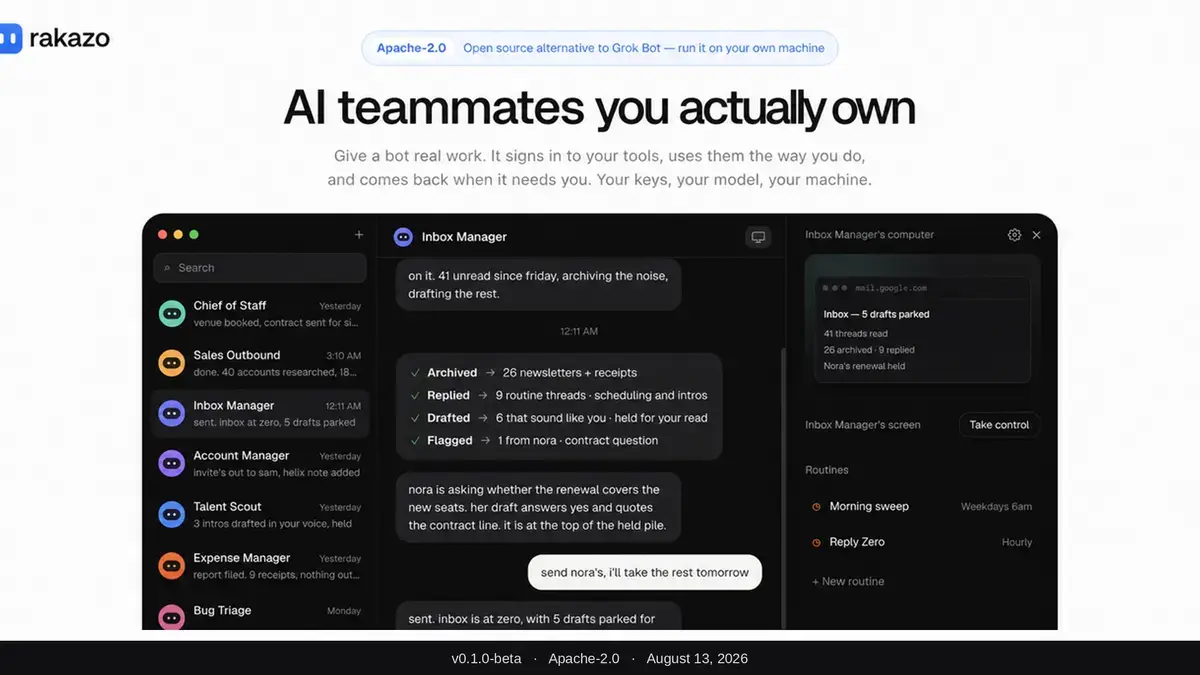
Rakazo product artwork shows an Inbox Manager bot alongside its conversation, computer panel and routines. Source: agentriot.com.
The retained documentation is explicitly for v0.1.0-beta, so it should not be treated as a description of every later release. It does, however, establish the architecture the project was asking users to operate: a bot has a thread, a computer, memory, routines and history, while web, Electron desktop and mobile applications are clients of the same API.
That distinction is easy to lose in the desktop-app framing. Opening the Electron client does not put an agent’s commands on the user’s laptop; the beta README says those commands still run through a selected Docker or E2B provider. In other words, the product is a runtime with multiple interfaces, not merely a chat application with a desktop shell.
| Milestone in the retained release record | Date shown | What it establishes |
|---|---|---|
v0.1.0-beta | August 13 | The initial tagged prerelease and the version of the retained README and self-hosting guide. |
v0.1.0 | September 3 | A numbered release after the beta. |
v0.1.6 | September 8 | The latest retained tag, with changes including desktop settings and server switching. |
The cadence limits one easy criticism—that this was only a one-day code drop. But it also limits a stronger conclusion in the other direction. The release list records changes, such as security and reliability fixes and revised local-access guidance; it does not provide a benchmark, a customer deployment record or a test of the product’s advertised business roles.
Rakazo’s site says its Apache-2.0-licensed self-host edition runs with the user’s model keys and advertises editable Markdown routines, approvals and an operator-owned audit log in the product description. The beta README describes the local prerequisites more concretely: Node.js 22 or later, pnpm 9, Docker Desktop for Postgres and the graphical computer, plus an API, a Graphile Worker and a sandbox supervisor.
The self-hosting guide is even clearer: a signed-in deployment is a long-running API, Graphile Worker, Postgres and a computer provider—not a static site. A public installation adds HTTPS origins, careful sign-up controls and durable storage for bot homes and artifacts. The documentation says the first registered user becomes the deployment owner.
That makes “self-hosted” a governance and operations decision as much as a licensing decision. The product’s version-one guidance says users bring their own model keys; it does not offer Rakazo-managed model billing. A forthcoming Cloud service is described as using the same codebase and the user’s keys, but the current public site labels it “Coming soon.”
The claim that self-hosting means “no seats, no limits” is consequently a licensing slogan, not a statement that agents have no resource constraints. The retained materials do not provide a like-for-like price comparison with Grok Bot or another hosted agent service. What they do establish is that the operator must supply model access and run or procure the computer environment.
Rakazo’s beta materials identify three live modes with sharply different exposure. Docker is the default local path; E2B is a remote sandbox; and a separate desktop provider runs commands on the API or worker host. The Electron client should not be confused with that last option.
| Provider | Documented fit | Material limitation |
|---|---|---|
| Docker | A trusted, single-machine local deployment | The supervisor controls the local Docker daemon; its port must remain private. |
| E2B | Public or multi-user deployments | It requires an E2B API key and puts the computer environment with that provider. |
| Desktop provider | A trusted user intentionally granting local access | Model-initiated shell commands run with the API or worker process’s operating-system permissions. It is not for a public or shared service. |
Those are project instructions, not an independent security certification. Still, they are a useful corrective to the frictionless “AI teammate” framing. The self-hosting guide says a public single-machine Docker setup shares a Docker host between bot containers and recommends E2B for public or multi-user production. It also warns that access to the Docker supervisor is equivalent to control of the Docker host.
A technical examination reaches a compatible conclusion while adding an important limitation: the homepage’s inbox manager, talent scout and other jobs are marketing roles, whereas the documented starting path is to create a bot, select a model and send it a message. The outlet also reported optional PostHog configuration in an environment file; that is not evidence that a tracker is active, but it means the site’s absolute “nothing phones home” language should not be read as a verified guarantee.
Rakazo’s model and sandbox flexibility is a real distinction from a product tied to one hosted control plane. An early analysis argued that model portability could matter to teams trying to avoid rebuilding their setup when provider options change. That is a plausible strategic benefit, not evidence that an open implementation will become the practical choice for most users.
The evidence in the retained record does not compare model quality, task success rates, hosted-service support, total cost or security outcomes across Rakazo and Grok Bot. It also does not establish that every advertised template is a ready-made workflow. Calling Rakazo a “clone” therefore obscures the more defensible comparison: it is an early, self-operated agent runtime with a stated alternative model-and-sandbox architecture.
The next decision is whether Rakazo can turn that architecture into a dependable public or organizational deployment. The most useful evidence would be repeatable isolation tests across its provider options, clear defaults for public installations, and documented results for agents operating with real credentials and approval gates.
Until that evidence appears, prospective users can make a narrower judgment. The project has a continuing release cadence and unusually explicit instructions about durable services and sandbox risks. But teams seeking a managed product with vendor-operated billing, infrastructure and accountability should treat the Cloud offering as future-facing copy, not an available substitute. Rakazo offers control of the runtime; it does not remove the work—or the responsibility—of running one.
A 2,000-cubic-metre tank and mobile pumping capacity address northern Hong Kong flooding, while AI tools help position crews and detect rising water. Official records distinguish established monitoring from three-site forecasting trials, with costs disclosed but comparative performance results absent.
Reported server price demands reach 45% above earlier agreements. HPE explicitly permits repricing before shipment, while XTX's disputed Dell order raises a sharper question: what happens when a buyer says it paid extra for a fixed price?
OpenRouter disclosed provider removals after investigations into inference data handling. Separate notices describe forwarded requests, a compromised deployment and stolen prompt samples, exposing different weaknesses behind privacy assurances.
Employee equity at Anthropic’s IPO price is reportedly worth $232 billion, while book rightsholders await a first settlement installment estimated at $2,203.56 per work. Vesting, shared copyrights and founder voting rights complicate the comparison.
Moore Threads is preparing a December 29 reveal for Lushan, a desktop GPU pitched at gaming and local AI inference. Its claimed memory record remains unquantified, and capacity alone will not establish performance or value.

Amazon is in advanced talks to buy Decart, whose software helps AI models run efficiently across chips. The reported deal could strengthen AWS’s Trainium business, with conditional payments and five-year founder commitments making execution central to its value.
The University of California is expanding ChatGPT and Codex access across 10 campuses, with extra charges for advanced models and an unresolved dispute over faculty authority.
Ray-Ban’s US store cuts the Gen 2 Wayfarer by 25% to $284.25. Buyers still face separate prescription-lens prices, a cheaper Gen 1 option and newer glasses outside Meta’s frame sale.
Ubisoft has made the team behind its Teammates experiment a dedicated subsidiary targeting AI characters with memory and outside game creators. Earlier playtests show both progress and limitations, while commercial plans remain undisclosed amid group cost cuts and refinancing.
Neuralink has shown a trial participant controlling GTA VI through intended movements. Earlier gaming use and company-reported trial results put the demonstration in context, while its reliability across users remains unmeasured in the reports.
SoftBank founder Masayoshi Son reportedly explored financing a $1 trillion acquisition of memory-chip maker SK hynix, but the company says the deal is no longer under active consideration. The target brings surging earnings, existing shareholders and customer commitments that complicate any simple equation between ownership and access to AI-memory supply.
Nvidia reported $115.8 billion in quarterly revenue, but its shares fell 14% Friday amid a wider technology selloff, a leadership transition and a reported accounting investigation. Strong cash generation offers a counterweight to concerns about the durability of AI spending.
The Nasdaq 100 fell 5.6% on November 20 and closed 19.8% below its record after an intraday bear-market breach. Nvidia’s revenue surge and Anthropic’s huge IPO did not halt the rout; infrastructure bills and resilience elsewhere in the market complicate the picture.
Reporting traces how Megaspeed gained access to Nvidia chips through an unlisted Inspur subsidiary and alleges links to a Cambodian smuggling intermediary. Company denials, differing customs totals and an unresolved criminal investigation complicate the account.
Together AI says an intruder downloaded stored samples of June and July API prompts and searched them for credentials. Zero data retention is now the default for new accounts, but the number of affected customers remains undisclosed.
Users describe grief and physical distress when AI relationships end, whether they choose to leave or the service changes. Research on attachment and farewell tactics raises questions about how providers measure engagement, manage updates and protect intimate data.
UN-backed talks agreed on two more years of work toward an autonomous-weapons instrument, without committing to a treaty. Consensus kept major military powers involved while allowing opponents to weaken the mandate.
Tesla is sending FSD v15 to its first customers, adding a visualization of planned driving and changes to navigation and hazard detection. The software remains supervised, and its claimed 25-fold intervention improvement lacks a disclosed baseline.
OpenAI reports sharply lower reasoning-extraction rates in internal GPT-6.2 tests and backs sanctions against illicit foreign distillation. Its own research and rival Anthropic’s experience show why protecting hidden reasoning leaves capability transfer and customer costs unresolved.
Alberta proposes 600-metre setbacks for large data centres and expanded utility oversight, but exemptions and rules still to be written will determine how much protection communities receive.