Editorial Team
8 min read
T3 Code has removed analytics code that derived user identifiers from Claude and Codex sign-in files. The change ends a way to recognize accounts across installations, while leaving default-on usage collection and questions about previously collected records.
T3 Code, an open-source control panel for AI coding agents, has removed analytics code that used OpenAI and Anthropic account identifiers to recognize users across installations. The change merged on November 24 stops analytics from opening the sign-in files of OpenAI's Codex and Anthropic's Claude Code, replacing that identity with a hash of a random installation ID.
The change addresses a specific tracking mechanism: the old version could recognize provider accounts before anyone signed in to T3 Code, even after the application and its data were removed and reinstalled. It leaves a separate policy dispute unresolved—collection remains enabled by default, with no product-telemetry switch in the app's settings reported as of November 25.
T3 Code does not supply its own AI model or sell model credits. It brings existing coding agents into one interface and lets users control work running on a computer or server from their phone. Those agents read and modify project files and execute commands. A reconstruction of the dispute describes that broad operational access; the privacy question is how much of it should also serve product measurement.
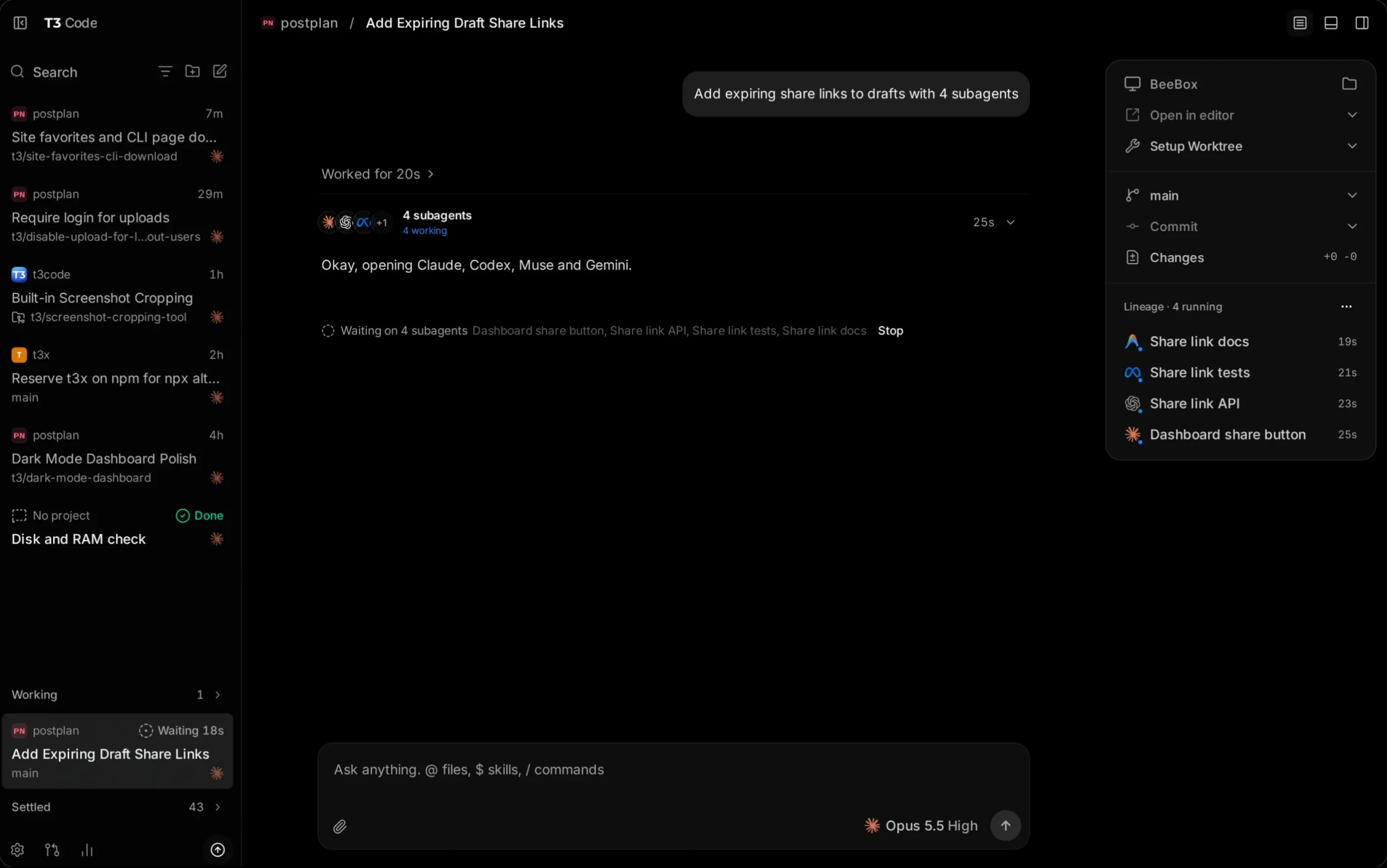
T3 Code's official product screenshot shows multiple coding agents working within one interface. Image: T3 Tools. Source: Frandroid.
The merged change describes analytics opening ~/.codex/auth.json and ~/.claude.json at startup and sending hashes of identifiers found there, both as an analytics identity and as account associations for an installation. These are other tools' authentication files. Removing those analytics reads does not remove the authentication needed to operate the agents.
The replacement implementation makes distinctId and installId the same hash of a random ID saved in T3 Code's state directory. Server-side account associations now come only from a linked T3 Connect account, used for T3 Code's remote connection service. Connecting clients can add Connect and device associations. Provider-account tracking has therefore ended in this implementation, while measurement across installations remains possible through T3's own service.
The fix appeared in nightly build 0.1.12-nightly.20261124.5209 on November 24. The subsequent reconstruction identifies stable v0.1.12 as carrying the fixes; its release page confirms publication on November 25. That chronology matters: the earlier network test correctly described the regular download as still affected when it was conducted.
An independent network test installed stable v0.1.11 on an Apple Silicon Mac and decrypted its outgoing requests with mitmproxy. About ten seconds after first launch, before interaction or sign-in, the application sent hashes derived from provider accounts already signed in on that machine.
The test identified an unsalted SHA-256 hash of the Codex account ID as distinct_id, plus installation-owner events containing hashes of an OpenAI user ID and a Claude account UUID. After removing the application and its remaining data directories, the tester reinstalled it. The installation ID changed; all three account hashes stayed the same.
The tester also calculated hashes from known account identifiers and matched the transmitted values. Hashing concealed the original strings while retaining their usefulness for matching: someone who already held an account ID could calculate its hash and find matching records. The result does not show that an arbitrary observer could reverse every hash.
The same test searched uploads for authentication tokens, names and email addresses and found none. Invented markers placed in a prompt, file contents, and file and folder names also did not appear in outgoing data. That supports a narrower conclusion than the viral allegation of stolen API keys: persistent account identification was observed, credential theft was not.
The limits matter. This was a test of one version on macOS, not Windows, Linux or the replacement stable release. It showed what left the computer, not what happened to records after ingestion. The report traces Codex-based identification to March and the additional OpenAI and Claude owner hashes to October, so the practice was not introduced only in v0.1.11.
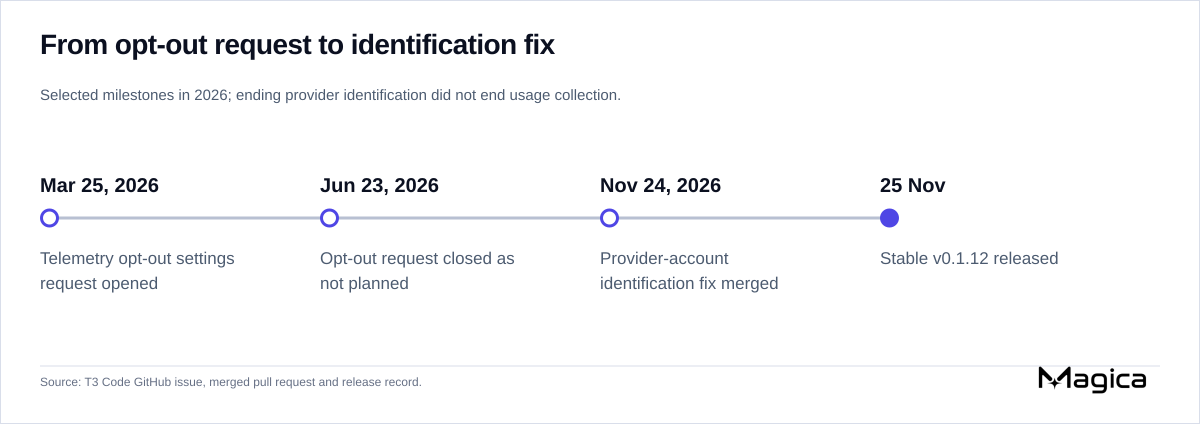
The request for a visible telemetry switch preceded the November identification fix by several months. Stable v0.1.12 was published on November 25. Source: GitHub — Telemetry opt-out request.
Theo Browne, T3 Code's CEO, is a former Twitch engineer whose developer-tool projects include T3 Chat and UploadThing. His T3 brand and public following give him a direct stake in both the software's reputation and the dispute over copies of it. T3 Code's source is MIT-licensed, allowing others to copy and modify it; the report identifies its protected brand as belonging to T3 Tools.
The immediate backlash followed Browne's November 23 joke calling a Chinese copy using the software's name “Temu3 Code.” The next day, the developer posting as 陈大黄 (@realchendahuang) published the accusations. The network-test report identifies him, citing his X profile, as an AI-company partner in Ningbo. It notes that he recommended the competing Stardust Agent about 90 minutes later, calling it an ethical alternative without telemetry. That report did not test Stardust Agent. His promotion of a substitute supplies context for the campaign, but does not invalidate the separately observed tracking behavior.
Browne said provider hashes solved a counting problem: one person on several machines otherwise appeared as several users. Without that deduplication, he said, the count would exceed three million. That is his description of an inflated metric, not a verified audience size. He also said the Claude hashes had been broken; the Mac test establishes transmission and persistence in that setup, not how reliably the mechanism counted all users.
His initial announcement described removing intrusive telemetry. His fuller explanation denied uploading files or prompts and promised publication of 95,789 of his own analytics events. The subsequent reconstruction reports that he later denied removing any telemetry or having intrusive telemetry. The code change is more specific than either broad characterization: it removes provider identification, while retaining usage events. His personal event history cannot establish the handling of every user's historical records.
Objections to collection long predate the fork dispute. A request for a settings toggle opened on March 25 was closed as not planned on June 23. T3 Code maintainer Julius Marminge said the team would not make opting out easier because counting users was crucial. The same thread records users objecting to persistent identifiers and to rejection of a contributed toggle.
The reconstruction also identifies a May homepage promising no telemetry without opting in, despite collection already being active by default, and a June redesign that removed the promise. The network-test report found that the welcome screen and privacy policy described anonymous usage data without mentioning account identifiers. Technical documentation did disclose hashed provider-account identifiers, but not the login files from which they came. The dispute concerns disclosure and consent as well as the contents of transmitted events.
T3 Code's telemetry documentation says product events go to its own ingestion endpoint, which retains a copy and forwards events to the analytics platform PostHog. Events include provider and model information, reasoning effort, permission mode, results, durations and token counts when available. The documentation says ordinary product events exclude prompts, responses, file contents and authentication tokens.
A follow-up change merged on November 24 limits another potential source of identifying text. Its description says unrecognized model IDs had been sent verbatim, including user-configured names such as Azure deployment names or model filenames. Unrecognized IDs now receive generic labels such as custom:ollama; catalogued models retain their catalog names, including when served through a custom endpoint. This supersedes the earlier documentation's blanket statement that custom model IDs were included.
The nightly release also lists removal of callers' IP addresses and user agents from relay traces, a separate analytics device ID on mobile, and a fix applying the saved Windows telemetry opt-out. These changes broaden the response beyond the two provider login files. They do not establish that usage collection itself has stopped.
The documented server opt-out is T3CODE_TELEMETRY_ENABLED=false, set before startup. The desktop application reads it from shell profiles on macOS and Linux and from user environment variables on Windows; administrators can also use managed policy. The subsequent reconstruction reports support for DO_NOT_TRACK=1 and disabling telemetry on continuous-integration servers in v0.1.12, while reporting that product telemetry remains on by default with no settings switch.
In the v0.1.11 Mac test, the environment setting stopped product events but a startup diagnostic still reached the logging service Axiom. The tester attributed that to the application deciding whether to send it before loading shell settings. This is an observed limitation of that version and launch method, not a test of the fixes.
The documentation also distinguishes data flows that a single server opt-out does not cover:
Agent feedback is off by default. When enabled, it can include conversation text only through an additional attachment approved by the user. Unlike the separate flows above, saved feedback reports are not sent when product usage data is turned off, according to the documentation.
The identification fix changes future collection by the updated code. It does not establish whether previously collected provider hashes have been deleted or how long retained copies remain. A clear account of those historical records, a test of the new release's outgoing traffic, and a decision on a visible product-telemetry switch would address the questions that removing provider-file reads leaves open.
Sber has released two GigaChat 4 language models for multistep work with million-token context windows. The flagship has an MIT license, while the smaller model restricts commercial use. Sber’s tests show substantial gains over GigaChat 3.5 alongside regressions and gaps against rivals, while deployment economics remain unclear.
JPMorgan and Citi are reportedly marketing AI loan portfolios as banks seek to manage risk or make room for more lending. The Bank of England warns that increasingly complex financing obscures exposures, while the undisclosed deal terms leave the extent of any protection unclear.
Polymarket’s H100 rental-price perpetual offers up to 3x leverage and a $30,000 launch reward pool that can grow to $120,000. Its spot benchmark excludes long-term capacity contracts, limiting the scope of potential hedges.
Bank of England governor Andrew Bailey says newer AI models are worrying their developers. The central bank wants financial firms to strengthen cyber defence and recovery while preparing for quantum-resistant cryptography, with the most systemically important firms moving ahead of national migration milestones.
Huawei’s ISSCC 2027 paper lists a custom memory interface twice HBM4’s width. Its commercial significance depends on bandwidth, manufacturing scale and cost, as China’s AI chipmakers face expensive, restricted memory supplies.
Ubisoft employees say new project pitches must explain how generative AI will be used or why it is unsuitable. The Assassin’s Creed publisher denies mandatory use, leaving questions about how teams secure approval without it.
Stanford physicist Venkatesa Chandrasekaran reports finite gravitational calculations and months of work with GPT-6 Astra. An early critique challenges the construction’s symmetry, finite-state and classical-limit claims.
SAP reportedly weighs at least 10,000 job cuts as it shifts toward AI. Labor negotiations, an earlier restructuring and a growing cloud business complicate the eventual employment and savings tally.
Poland plans to sign a Palantir software agreement on November 27 after years of military trials. Officials promise Polish control of data and access, but the available reporting gives no price, rollout timetable or comparative performance results.
Major software stocks rallied as chips fell, but an estimated $65 billion of software loans comes due in 2028–29. Higher loan yields and slower refinancing threaten indebted borrowers even as established vendors report revenue growth and expanding AI businesses.
Christophe Fouquet argues that selling China older lithography tools can preserve Western leverage. ASML’s commercial exposure and China’s ability to stretch older technology complicate that case.
Savage Technology is taking reservations for its first product: $799 Orrorin glasses promising displays for both eyes and gestures without a wristband. Meta’s display-and-band bundle launched at the same price; Savage still faces engineering validation and estimated 2027 delivery.
Z.AI’s next flagship model is reportedly behind schedule as rival providers tighten distillation defenses. US licensing rules for overseas computing threaten further delays, with Moonshot forecasting longer release cycles if its access is cut off entirely. Interim releases and alternative suppliers complicate the picture.
Capita is seeking fresh equity and creditor support after replacing its chief executive. Pension recovery costs are only part of its profit downgrade, while government figures show unresolved cases still growing.
Provisional CBS figures show AI use more than doubled among Dutch businesses with at least two workers in 2026. Text generation spread rapidly, while reported productivity gains leave the size of the economic payoff unresolved.
The Global Electronics Association says AI servers are absorbing scarce circuit-board materials and crowding out other industries. New factories are coming, but upstream constraints and uncertain demand complicate the response.
Google says Gemini Live’s Guided Vision is available on iOS, extending visual descriptions and spoken camera-framing help to iPhone users. Device eligibility and regional coverage remain unclear, and Google warns against using it for navigation.
The Dutch government wants Congress to keep the MATCH Act out of its annual defence bill. The proposal would tighten controls on ASML’s China business, including servicing, despite existing Dutch restrictions on advanced chipmaking equipment.
The London startup’s pre-seed round backs research and testing for patient-facing AI. Its founders bring medical-device deployment experience, but benchmark findings and customer submissions do not yet establish real-world safety.
Switzerland’s cybersecurity chief says five confirmed AI-agent attacks affected businesses including three critical-infrastructure operators. Four attacks breached systems, but no major outages were reported, and the public evidence leaves the attackers and specific consequences unknown.