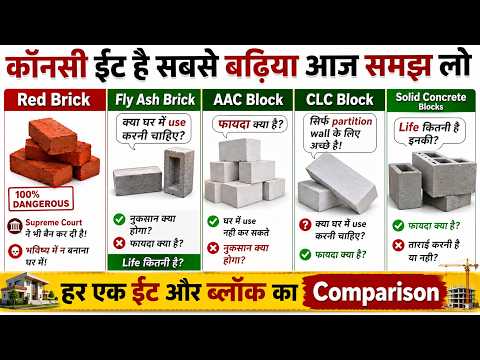
In this article, we will explore the differences between four popular building materials: Red Brick, Fly Ash Brick, AAC Block, and CLC Block. We will analyze their properties, strengths, weaknesses, and determine which material is best suited for your construction needs.
1. Raw Materials
Red Brick
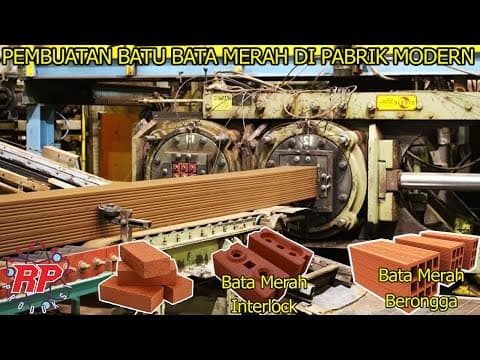
Red bricks, also known as fired clay bricks, are one of the oldest and most traditional building materials. The primary raw materials used in making red bricks include:
- Clay: The main raw material, sourced from locally available natural soil.
- Shale: Sometimes mixed with clay to enhance properties.
- Water: Acts as a binder to shape the bricks.
- Combustible Materials: Used to fire the bricks at high temperatures (900 to 1200 degrees Celsius).
Fly Ash Brick
Fly ash bricks are made from a mixture of:
- Fly Ash: The primary raw material.
- Cement, Sand, and Water: Combined to form the bricks.
AAC Block (Autoclaved Aerated Concrete)
AAC blocks are produced using:
- Cement, Sand, Lime, Aluminum Powder, Water, and Resin Agent.
CLC Block (Cellular Lightweight Concrete)
CLC blocks are made from:
- Cement, Sand, Water, and Foaming Agent.
2. Shape and Size
Red and fly ash bricks typically come in standard sizes:
- Standard Sizes: 190 x 90 x 90 mm and 190 x 90 x 40 mm.
- Non-standard Sizes: 230 x 110 x 75 mm and 230 x 110 x 30 mm.
AAC and CLC blocks also have standard sizes, including:
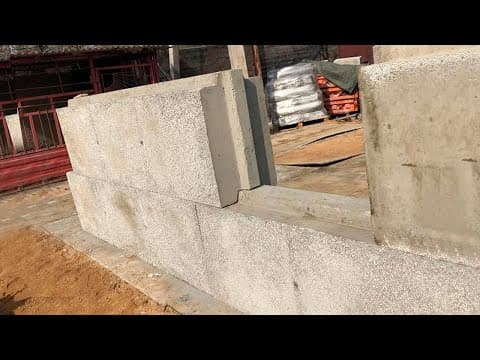
- 4-inch Block: 625 x 200 x 100 mm
- 6-inch Block: 625 x 200 x 150 mm
- 8-inch Block: 625 x 200 x 200 mm
- 9-inch Block: 625 x 200 x 225 mm
3. Compressive Strength
Compressive strength indicates how much load a brick can bear:
- Red Brick: 3.5 to 10 N/mm² (35 to 100 kg/cm²).
- Fly Ash Brick: 10 to 12 N/mm² (100 to 120 kg/cm²).
- AAC Block: 3 to 5 N/mm² (30 to 50 kg/cm²).
- CLC Block: 2.5 to 3 N/mm² (25 to 30 kg/cm²).
- Solid Concrete Block: 3 to 7 N/mm² (30 to 70 kg/cm²).
4. Mortar Consumption
Due to irregular shapes and sizes, red bricks consume more mortar, leading to higher labor costs. In contrast, fly ash, AAC, CLC, and solid concrete blocks require less mortar due to their uniform surfaces, reducing overall costs and speeding up construction.
5. Water Absorption
Water absorption rates are crucial for durability:
- Red Brick: Should not absorb more than 25% of its weight.
- Fly Ash Brick: Absorbs 6 to 12% of its weight.
- AAC Block: Absorbs less than 10% of its weight.
- CLC Block: Absorbs 7 to 12% of its weight.
- Solid Concrete Block: Absorbs less than 10% of its weight.
6. Dry Density
Dry density varies among these materials:
- Red Brick: 1600 to 1920 kg/m³.
- Fly Ash Brick: 1700 to 2000 kg/m³.
- AAC Block: 550 to 850 kg/m³.
- CLC Block: 600 to 800 kg/m³.
- Solid Concrete Block: 1800 to 2500 kg/m³.
7. Water Usage During Manufacturing
Water usage during the manufacturing process varies:
- Red Brick: Requires about 1.5 liters of water per brick.
- Fly Ash Brick: Uses less water for mixing.
- AAC Block: Requires minimal water due to steam curing.
- CLC Block: Also requires less water due to steam curing.
- Solid Concrete Block: Requires significant water for curing.
8. Breakage and Utilization
Breakage rates during transportation and usage differ:
- Red Brick: 10 to 12% breakage.
- Fly Ash Brick: Minimal breakage, allowing for 100% utilization.
- AAC Block: Breakage tolerance of 3%.
- CLC Block: Very low breakage.
- Solid Concrete Block: 100% utilization due to high strength.
9. Thermal Conductivity and Heat Insulation
Thermal conductivity affects energy efficiency:
- Red Brick: 0.5 to 1 W/mK.
- Fly Ash Brick: 0.90 to 1.05 W/mK.
- AAC Block: 0.1 to 0.7 W/mK.
- CLC Block: 0.32 to 0.37 W/mK.
- Solid Concrete Block: 0.7 to 1.28 W/mK.
10. Sound Insulation
Sound insulation properties vary:
- Red Brick: Reduces sound by 45 to 50 dB.
- Fly Ash Brick: Reduces sound by 37 to 39 dB.
- AAC Block: Reduces sound by 40 to 50 dB.
- CLC Block: Reduces sound by 37 to 42 dB.
- Solid Concrete Block: Reduces sound by 51 dB.
11. Termite Resistance
- Red Brick: Not resistant to termites.
- Fly Ash Brick: Resistant to termites.
- AAC Block, CLC Block, and Solid Concrete Block: All are resistant to termites.
12. Environmental Impact
- Red Brick: Negative impact due to deforestation and soil degradation.
- Fly Ash Brick: More environmentally friendly as it utilizes waste from thermal power plants.
- AAC and CLC Blocks: Recyclable and emit less CO2 during manufacturing.
- Solid Concrete Block: Requires less water and emits less CO2 compared to red bricks.
13. Cost Considerations
While red bricks are cheaper per unit, their overall construction cost can be higher due to increased labor and material requirements. Fly ash bricks are cost-effective but may have higher overall costs due to mortar requirements. AAC and CLC blocks, while individually more expensive, can reduce overall costs due to lower labor and material needs.
Conclusion
Choosing the right building material depends on your specific needs. If you prioritize cost and are willing to compromise on strength, AAC blocks may be suitable. However, if strength is a priority, fly ash bricks are recommended. Red bricks remain a reliable choice but come with environmental concerns. Ultimately, fly ash bricks offer a balanced solution for modern construction needs, combining strength, cost-effectiveness, and environmental sustainability.