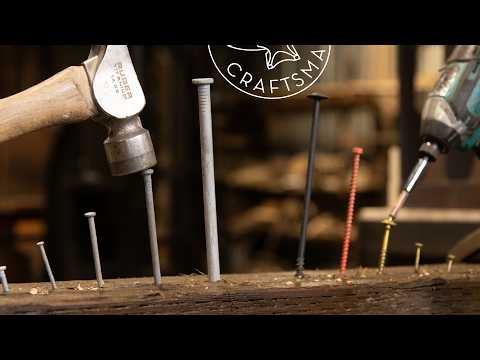
Despite the convenience and advancements in screw technology, nails remain the preferred fastener in house construction due to cost, speed, and engineering principles. This article explores the reasons behind this choice, the types of nails used, and the advantages of both nails and screws in construction.
In the world of construction, the debate between using nails versus screws has been ongoing. As we move into 2025, one might wonder why nails are still the go-to fasteners for building houses, especially when screws have become more advanced and widely available. This article delves into the reasons behind this preference, the types of nails commonly used, and the engineering principles that guide these choices.
One of the primary reasons nails are favored over screws in house construction is cost. While screws offer convenience and a variety of options, they are generally more expensive than nails. In a world where budget constraints are a reality for many homeowners, using nails can significantly reduce construction costs.
Nails can be driven in quickly, allowing for faster assembly of structures. For instance, a set of nails can be installed in about five seconds, whereas screws may take significantly longer due to the need for drilling. This speed is crucial in construction, where time is often of the essence.
From an engineering perspective, nails provide sufficient strength for most applications. The safety margin in construction is typically designed to be at least two and a half to one, meaning that nails can meet the necessary strength requirements without being excessively strong. In many cases, nails can achieve the required structural integrity without the need for the additional strength that screws provide.
While nails are often the preferred choice, there are specific scenarios where screws are necessary. For connections that require a stronger hold or where components need to be disassembled later, screws are the better option. Structural screws, for example, are used in applications where a single fastener must bear significant loads, such as attaching trusses to top plates.
As a carpenter with over 46 years of experience, I have encountered various types of nails, each serving specific purposes. Here are some of the most commonly used nails in construction:
Duplex nails are designed for temporary structures, such as scaffolding. They can be driven in while leaving the head exposed for easy removal.
The 16 penny and 8 penny sinker nails are among the most frequently used nails in framing. Their smooth glue coating allows for easy driving and strong holding power.
Specialty nails, such as finish nails and galvanized nails, are used for specific applications. Galvanized nails are essential for outdoor projects due to their corrosion resistance.
Nail guns have revolutionized the construction industry, allowing for rapid installation of nails. They come in various brands and types, each designed for specific applications.
While nail guns have made the process easier, the skill of hand nailing should not be overlooked. Mastering the technique of driving nails by hand can enhance a carpenter's effectiveness and adaptability on the job site. The ability to control the hammer's descent and aim accurately is a skill that takes time to develop but is invaluable in construction.
In conclusion, while screws have their place in construction, nails remain the preferred fastener for building houses due to their cost-effectiveness, speed, and sufficient strength for most applications. Understanding the different types of nails and their uses can help builders make informed decisions that benefit their projects. As we continue to innovate in construction, the balance between traditional methods and modern technology will shape the future of building practices.