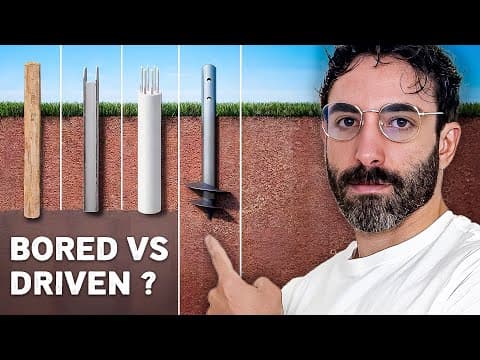
This article explores the various types of pile foundations, including driven piles, screw piles, bored piles, and micropiles. It discusses their installation processes, advantages, disadvantages, and when to choose each type based on soil conditions and structural requirements.
In the construction industry, pile foundations play a crucial role in providing support for structures by transferring loads to deeper soil layers. This article delves into the most popular types of pile foundations, including driven piles, screw piles, bored piles, and micropiles. We will explore the pros and cons of each type, their installation processes, and guidelines for selecting the appropriate pile foundation for your project.
A pile foundation is a type of deep foundation that consists of long slender columns or piles, typically made of concrete, steel, or timber. These piles are driven or installed into the ground to provide support for structures by transferring loads to deeper levels within the Earth.
Pile foundations can be classified into two main categories:
Additionally, there are three subcategories based on their load-bearing mechanisms:
Several factors influence the decision to use pile foundations over other options:
The soil's bearing capacity is a critical factor. For instance, most residential projects require a minimum bearing capacity of 100 kPa. If the geotechnical report indicates weak soil layers, such as uncontrolled fill or loose sand, piles may be necessary to ensure stability.
Light structures, such as tall buildings and carports, may face significant lateral and uplift forces. Piles can provide stability due to their friction capacity, making them a more efficient choice than shallow footings, which can become massive and costly.
When introducing new structures, their footings can exert additional loads on existing foundations. Piles can help mitigate this pressure, preventing potential damage to neighboring structures or utilities.
In areas where the water table is close to the surface, constructing shallow footings can be challenging. Piling can avoid the need for extensive dewatering, ensuring a stable construction environment.
Using shallow footings on slopes can reduce stability. While shallow footings are possible, considering a pile foundation can help avoid landslide and stability issues.
Bored piles are high-capacity drilled peers created by drilling a cylindrical hole and filling it with concrete. They may require a reinforcing cage and can have an enlarged base for added support.
Pros:
Cons:
Screw piles consist of circular steel hollow sections with a helix at the tip. They are installed using hydraulic excavators and are popular in residential construction.
Pros:
Cons:
Driven piles are installed using impact or vibration hammers. They can be made from steel, timber, or precast concrete and are classified as displacement piles.
Pros:
Cons:
Frankie piles are driven cast-in-situ piles that use a drop weight and temporary casing to create an enlarged base.
Pros:
Cons:
Micropiles are mini bored piles used primarily to strengthen existing footings. They are installed using a steel casing and flushing method.
Pros:
Cons:
It is essential to exercise caution when using piles, especially on sites above closed landfills or hazardous waste areas. Drilling in these locations can expose hazardous materials, leading to dangerous conditions, including gas exposure or explosions.
Understanding the various types of pile foundations and their applications is crucial for successful construction projects. By considering soil conditions, structural requirements, and the pros and cons of each pile type, engineers can make informed decisions that ensure the stability and safety of their structures.