This blog post explores the essential question of how much closed cell spray foam insulation is necessary for optimal efficiency, highlighting the diminishing returns of insulation thickness and the importance of understanding BTU retention.
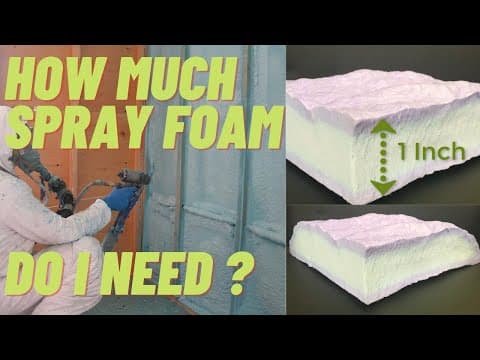
Spray foam insulation is a popular choice for many homeowners and builders, but a common question arises: how much spray foam insulation do I need? In this post, we will delve into the specifics of closed cell spray foam insulation, its efficiency, and the factors that influence how much is necessary for effective insulation.
Spray foam insulation comes in two types: open cell and closed cell. This discussion will focus solely on closed cell foam due to its unique properties and applications. The insulating value of spray foam is achieved through the blowing agent trapped within the foam's cells. In closed cell foam, a freon-based blowing agent is used, while open cell foam utilizes water vapor.
To understand how much spray foam is needed, we can refer to the ASTM C236 guarded hotbox test, a standardized method for measuring insulation effectiveness. This test involves a 24 square foot insulated box maintained at a temperature of 20 degrees Celsius inside a cooler set at -20 degrees Celsius. The goal is to measure the BTUs lost per hour, providing a clear picture of insulation performance.
The test results show the following BTU loss for various thicknesses of closed cell spray foam:
As the thickness of the spray foam increases, the BTU loss decreases, indicating improved insulation performance. However, the rate of improvement diminishes after a certain point.
The efficiency of closed cell spray foam insulation shows significant gains with the first few inches:
After reaching 3 inches, the increase in heat retention becomes marginal, with only a 1% gain for each additional inch. This phenomenon is known as diminishing returns, which is crucial for homeowners and builders to understand when deciding on insulation thickness.
For most applications, including basements, attics, and walls, a thickness of 2 inches of closed cell spray foam is often sufficient. This thickness provides an excellent balance of cost and efficiency, achieving 86% BTU retention. In many cases, going beyond 3 inches does not yield significant benefits, making it an unnecessary expense.
It is important to note that building codes may dictate minimum R-values for insulation. However, these codes can sometimes lead to the application of excessive insulation thickness, which may not be justified by the actual performance gains. Understanding the relationship between thickness and efficiency can help homeowners make informed decisions that align with both building codes and practical insulation needs.
In summary, when considering how much closed cell spray foam insulation to use, it is essential to focus on efficiency rather than just thickness. Two inches of closed cell spray foam is typically adequate for most insulation needs, providing substantial heat retention without unnecessary costs. By shifting the conversation from R-values to actual BTU retention, homeowners and builders can make more sensible decisions regarding insulation.
For further insights into spray foam insulation and its applications, be sure to explore additional resources and videos that provide valuable information on this topic.