This blog post explores five improved wall assembly options for upgrading poorly constructed homes, focusing on better materials and methods to enhance performance, durability, and energy efficiency.
In a recent video, we explored the construction of a house deemed the worst built in America. While it met code requirements, the quality of construction left much to be desired. This post will delve into five wall assembly options that can significantly enhance the performance of such homes without incurring substantial additional costs.
The house we examined was built using traditional two-by-four construction with cardboard sheathing and standard fiberglass R13 bat insulation. While this setup is code legal in many areas, it often fails to meet air tightness requirements, which are becoming increasingly enforced. The goal is to not only meet code but to exceed it for better energy efficiency and durability.
In the U.S., building codes vary by climate zone. For instance, in climate zones one and two, a two-by-four wall with R13 insulation is permissible. However, as you move into colder zones, the requirements change, necessitating either R20 insulation in a two-by-six wall or R13 plus additional exterior insulation.
The first upgrade involves replacing cardboard sheathing with oriented strand board (OSB) sheathing and adding a mechanically attached house wrap, such as Tyvek. This change enhances the structural integrity of the wall and improves waterproofing, which is crucial for durability.
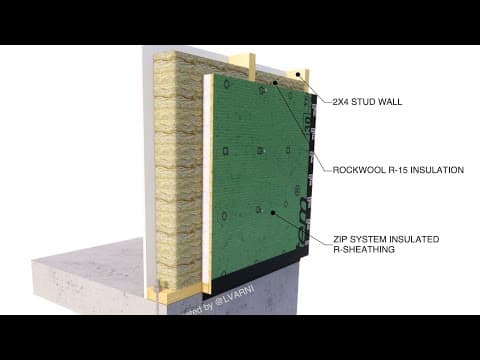
The second option is to use the Huber Zip System, which combines OSB sheathing with an integrated weather barrier. This system not only improves waterproofing but also enhances air sealing capabilities, which is vital for energy efficiency.
The third option involves using Zip R sheathing, which has insulation bonded to the sheathing. This method simplifies installation and provides continuous insulation, which is beneficial in all climate zones.
For the fourth assembly, we consider a two-by-six wall with high-density insulation and plywood sheathing. This option is particularly effective in climates with higher exposure to the elements.
The final assembly focuses on advanced waterproofing techniques, particularly at the base of the wall. By using pressure-treated lumber to protect the bottom of the foam insulation, we can significantly reduce the risk of rot and water damage.
Upgrading poorly constructed homes is not just about meeting code; it's about enhancing performance, comfort, and longevity. The five wall assembly options discussed provide a pathway to achieving these goals through better materials and methods. As we continue to explore more advanced assemblies in future posts, it's essential to remember that effective waterproofing and air sealing are paramount in building durable homes.
Stay tuned for more insights on high-performance construction and how to build better homes for the future.