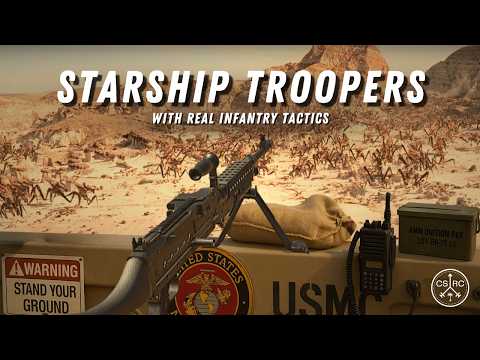
This blog post explores a hypothetical scenario where a modern U.S. Marine Corps unit defends Whiskey Outpost against an overwhelming swarm of alien arachnids, analyzing enemy capabilities, friendly force strengths, terrain, and a detailed battle plan to achieve victory.
In the realm of science fiction, few battles are as iconic as the one depicted in the film Starship Troopers, where the mobile infantry faces off against an overwhelming swarm of alien arachnids. But what if this scenario were to unfold in reality? This blog post delves into a hypothetical situation where a present-day military unit, specifically the United States Marine Corps, must defend Whiskey Outpost against 2000 alien bugs using realistic military tactics and strategies.
The backdrop of this analysis is the conflict between the United Citizen Federation and the Arachnids, a hostile alien species. The film portrays a catastrophic invasion of Earth, leading to a desperate battle at Whiskey Outpost, where the Rough Necks, a platoon of mobile infantry, are ambushed by the bugs. Our analysis will focus on how a modern military unit could effectively respond to such a threat.
The Arachnids, colloquially known as bugs, are insectoid aliens that operate in a hive-like manner. Their physiology varies by subspecies, but they are generally armored with tough exoskeletons and equipped with lethal claws and mandibles. Despite their lack of advanced technology, they excel in swarm tactics, coordinating their attacks through chemical or telepathic communication.
The primary objective of the Arachnids is to destroy all personnel within Whiskey Outpost. The brain bug, a key leader, orchestrates ambushes and adapts tactics based on human responses, making it a critical target for the Marines.
The Arachnids' strengths lie in their ability to execute masked swarm attacks, overwhelming defenders with speed and numbers. However, they are vulnerable to prepared defensive positions armed with ranged weapons, and their predictable assault patterns can be exploited by a well-prepared enemy.
For this scenario, we will replace the Rough Necks with a U.S. Marine Corps infantry battalion, specifically a single rifle company augmented with heavy support. The Marines are known for their adaptability, aggression, and combined arms integration, making them well-suited for this defensive operation.
The Marines possess superior marksmanship, discipline, and the ability to integrate various weapon systems effectively. Their mission is not just to survive but to retain control of Whiskey Outpost and degrade the Arachnid offensive capability.
Whiskey Outpost is situated in a rocky, barren desert characterized by jagged formations and narrow ravines. The terrain presents both opportunities and challenges for the defending Marines.
The Marines will develop an engagement area to maximize their defensive capabilities. This involves identifying likely enemy avenues of approach and establishing pre-sighted fields of fire.
Target reference points will be established to coordinate fire and trigger events during the battle. The final protective fire line will be used to disrupt any enemy breakthroughs.
As the Arachnid swarm approaches, the Marines are pre-positioned and ready to engage. The heavy machine guns and mortars begin firing as the bugs enter the kill zone, maximizing casualties.
As the battle progresses, the bugs adapt their strategy, pushing tankers to the front as shields. The Marines must quickly shift their focus to eliminate these threats before they can breach the compound.
Once the situation becomes dire, external air support arrives, providing critical firepower to thin out the remaining swarm. The combination of artillery and close air support ultimately turns the tide in favor of the Marines.
In this hypothetical scenario, a well-prepared U.S. Marine Corps unit could successfully defend Whiskey Outpost against an overwhelming Arachnid assault. By leveraging superior tactics, firepower, and coordination, the Marines would not only survive but decisively defeat the alien threat. This analysis highlights the importance of preparation, adaptability, and the integration of combined arms in modern warfare.