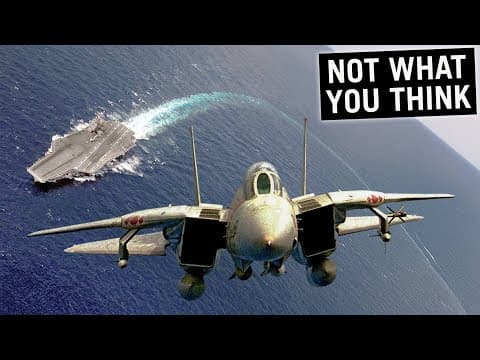
The F-14 Tomcat, iconic for its role in naval aviation, was originally designed to prevent dogfights by intercepting threats with its powerful Phoenix missiles. Despite its impressive capabilities, including variable geometry wings and advanced radar, the F-14 never fired a Phoenix missile in combat. This blog explores the aircraft's design, operational history, and the reasons behind its unique legacy.
When people think of fighter jets, the F-14 Tomcat is usually at the top of the list. Thanks to films like Top Gun and The Final Countdown, it has been credited with launching countless naval aviator careers. However, the F-14 was not originally designed for dogfights; rather, it was intended to prevent them from occurring in the first place.
In the 1960s, the US Navy faced a new threat from Soviet supersonic bombers and anti-ship cruise missiles. To counter this, they needed an aircraft capable of carrying six heavy missiles, flying faster than twice the speed of sound, and landing on an aircraft carrier. The initial solution was the F-111B interceptor, but Congress canceled the program due to its high costs and performance issues. This led to the rushed development of the F-14 Tomcat to fill the interceptor gap.
At the heart of the Tomcat's design was the AIM-54 Phoenix missile, a 1,000-pound, 13-foot long weapon. The F-14 was designed to carry up to six of these missiles, which necessitated a larger airframe. However, the aircraft's variable geometry wings limited the number of missiles that could be mounted on the wings, forcing engineers to place four missiles under the fuselage. This design choice required the engines to be spaced nine feet apart, which had both advantages and disadvantages.
The wide body of the F-14 allowed it to generate significant aerodynamic lift, which was crucial for its performance. This feature enabled an F-14 to land safely even after suffering a mid-air collision that sheared off half of its right wing. However, the wide spacing of the engines also posed a risk; if one engine lost power, the resulting asymmetric thrust could lead to a dangerous flat spin, which was difficult to recover from without ejecting.
The F-14 was notorious for its engine problems, with over 28% of crashes attributed to engine failures. The initial engines, the Pratt & Whitney TF30, were not designed for the agile fighter role, leading to frequent compressor stalls. It wasn't until the introduction of the F-14B and D variants, equipped with General Electric F110 engines, that these issues were resolved. The new engines provided significantly more thrust and improved fuel efficiency, allowing for greater operational range.
The F-14 featured several advanced technologies, including a microprocessor-controlled automatic wing-sweep system. This system adjusted the wing angle for optimal performance at various speeds, enhancing both lift during takeoff and landing and reducing drag at high speeds. The aircraft's distinctive rectangular air intakes were designed to prevent compressor stalls by regulating airflow to the engines.
The F-14's official nickname, "Tomcat," followed Grumman's tradition of naming aircraft after cats. The name was also a nod to the two key figures who advocated for the aircraft's development, both named Tom.
The F-14 was equipped with the AIM-54 Phoenix missiles, which were highly effective in beyond-visual-range combat. The aircraft's AN/AWG-9 radar could track multiple targets simultaneously, allowing for precise targeting of threats. The Phoenix missile could engage targets up to 100 nautical miles away and was designed to operate independently once launched.
In addition to the Phoenix missiles, the F-14 could carry various air-to-air missiles, including AIM-9 Sidewinders and AIM-7 Sparrows. It also featured an M61 Vulcan cannon for close-range engagements, addressing a significant limitation of its predecessor, the F-4 Phantom.
Despite its impressive capabilities, the F-14 did not achieve a significant aerial combat score in US Navy service. Ironically, the Iranian Air Force, which purchased F-14s in the 1970s, claimed numerous air-to-air victories during the Iran-Iraq War. The F-14's most notable achievement was when an Iranian pilot shot down three Iraqi MiG-23s with a single Phoenix missile.
Today, Iran remains the only country still operating the F-14, with a small number of aircraft still in service. After the US Navy retired its F-14s in 2006, most were destroyed to prevent parts from reaching Iran.
The F-14 Tomcat was designed for a mission that ultimately never materialized. Despite its advanced technology and impressive armament, the aircraft never fired a single Phoenix missile in combat. The F-14's legacy is one of innovation and adaptability, representing a unique chapter in naval aviation history. Its story serves as a reminder of the complexities and challenges of military aircraft design and the unpredictable nature of warfare.