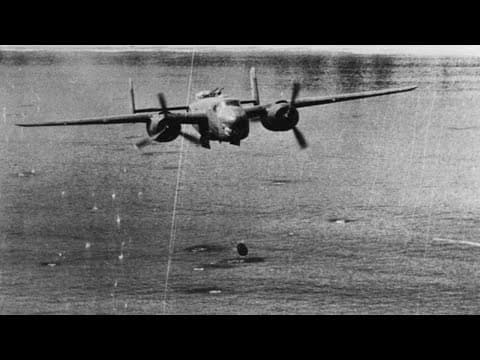
On March 3, 1943, the Japanese Navy faced an unprecedented attack from modified B-25 bombers equipped with eight .50 caliber machine guns. This tactical innovation turned the Bismar Sea into a killing field, leading to devastating losses for the Japanese convoy and fundamentally altering naval warfare in the Pacific. The B-25's transformation into a strafer gunship showcased American ingenuity and adaptability, marking a pivotal moment in World War II.
On March 3, 1943, a pivotal moment in naval warfare unfolded in the Bismar Sea. Rear Admiral Masattoi Kimura, commanding a resupply convoy, believed his eight destroyers and eight transport ships would safely deliver 6,900 soldiers to Lieutenant General Hatazo Adachi at La. However, unbeknownst to him, American mechanics had transformed B-25 Mitchell bombers into deadly gunships, equipped with eight .50 caliber machine guns. This innovation would soon turn the waters into a killing field, leading to catastrophic losses for the Japanese Navy.
The Japanese Navy's confidence stemmed from their previous victories at Pearl Harbor and the Java Sea. They believed their anti-aircraft defenses were sufficient to handle any aerial threats. Captain Tamichihara, commanding the destroyer Shigar, had successfully navigated these waters multiple times, relying on tactics developed to counter aerial attacks. The convoy was meticulously organized, with destroyers screening the transports, ready to respond to any threats.
The B-25 bombers had undergone significant modifications under the guidance of Major Paul Irvin Gun, known as "Papy." Frustrated by the ineffectiveness of high-altitude bombing against ships, Gun and his team installed additional .50 caliber machine guns in the nose of the B-25, transforming it into a strafer gunship. This modification allowed the aircraft to unleash a torrent of firepower, capable of penetrating the armor of destroyers and causing devastating damage.
The modifications required extensive reinforcement of the aircraft's structure and careful weight distribution. Each .50 caliber machine gun could fire 850 rounds per minute, and with eight guns firing simultaneously, the B-25 could unleash 6,800 rounds per minute. This firepower had a psychological impact on Japanese sailors, who described the terror of facing such a weapon.
As the convoy sailed, Japanese lookouts spotted American aircraft approaching. Initially, they believed they were facing a standard bombing formation of B-17s and B-25s at high altitude. However, the real threat came from the modified B-25s flying at wave-top height, undetected until it was too late.
The attack commenced with B-25s approaching at low altitude, catching the Japanese convoy off guard. Major Edward Lner led the assault, targeting the destroyer Shiryuki. As he opened fire, the impact was catastrophic; the destroyer's bridge was obliterated, and its anti-aircraft defenses were silenced. The B-25s continued their assault, targeting transports and destroyers with deadly precision.
In just 15 minutes, the convoy was transformed from a well-organized fleet into a scene of chaos and destruction. The Japanese ships, unprepared for such an aggressive and innovative attack, suffered heavy losses. The transport Oya Maru was particularly devastated, sinking rapidly with most of its 1,500 soldiers unable to escape.
By 10:15 a.m., Admiral Kimura realized the extent of the disaster. All eight transports were either sunk or sinking, and four destroyers were lost. The human cost was staggering, with fewer than 1,200 of the 6,900 troops reaching La. The psychological impact on the Japanese Navy was profound, as they faced a new kind of warfare that their traditional tactics could not counter.
The B-25's success marked a turning point in naval warfare. Admiral Isuroku Yamamoto recognized that Japan could no longer risk surface vessels in waters within range of American aircraft. The inability to protect convoys meant that resupply and reinforcement of forward positions became nearly impossible, effectively dooming Japanese garrisons throughout the Pacific.
Following the Bismar Sea victory, the B-25 Strafer became a standard model in the Pacific theater. The aircraft's design evolved, with later models incorporating even more firepower. The success of the B-25 influenced American military doctrine, demonstrating the effectiveness of field modifications and innovative tactics.
The psychological scars left by the B-25 Strafer were deep. Survivors reported nightmares and fear of aircraft, knowing that the modified bombers could appear at any moment. The Japanese military had to adapt quickly, developing new tactics to counter the threat, but these efforts were largely ineffective.
The B-25 Strafer represents one of the most significant tactical innovations of the Pacific War. Its transformation from a conventional medium bomber into a ship-killing machine showcased American ingenuity and adaptability. The legacy of the B-25 continues to influence military aviation, demonstrating that in warfare, the side that adapts fastest often prevails. The encounter between Japan and the B-25 Strafer was not just a battle of weapons but a revolution in naval warfare, reshaping the future of military strategy.