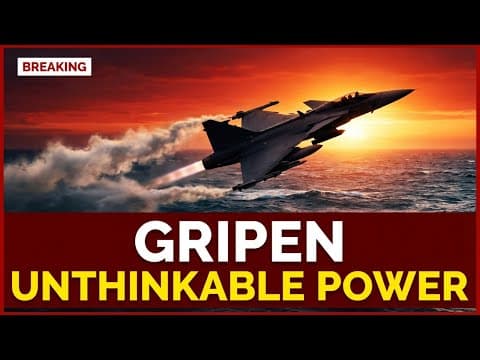
The Saab Gripen, once overlooked in favor of larger jets, made headlines when Colombia chose it over American and French competitors. This decision marks a significant shift in military procurement, showcasing the Gripen's advanced technology, cost-effectiveness, and strategic partnerships in South America, transforming it from an underdog to a formidable contender in the global fighter jet market.
For years, the fighter jet market has been dominated by major players like the United States, France, and Russia. The American F-35 and F-16, the French Rafale, and the Russian Su-57 have long been the go-to choices for nations looking to bolster their air forces. In contrast, the Saab Gripen, a smaller jet from Sweden, was often dismissed as a sensible but unexciting option. It was likened to the Volvo of the skies—safe and reliable, yet lacking the flair of its competitors.
The Gripen was frequently overshadowed by its larger counterparts, which boasted higher speeds and greater firepower. Analysts and pundits often pointed out its limitations, leading many to view it as a niche aircraft suitable only for countries with smaller budgets. This perception relegated the Gripen to the sidelines, where it was respected but rarely considered a serious contender in the global arena.
Saab, the manufacturer, did not help its cause by remaining relatively quiet in the face of competition. While other defense giants made bold claims and showcased their hardware, Saab focused on refining the Gripen, emphasizing efficiency and clever engineering. This approach, while practical, did not capture the attention of decision-makers who were drawn to the flashier options.
In April 2025, the landscape shifted dramatically when Colombia announced its decision to purchase the Gripen over more established options like the F-16 and Rafale. This unexpected choice sent shockwaves through the defense community, as experts had anticipated a victory for one of the traditional powerhouses. The Gripen's triumph was a classic David and Goliath moment, challenging the notion that bigger and more expensive automatically equates to better.
The competition had been fierce, with the U.S. exerting pressure to block the sale by attempting to restrict the export of the Gripen's American-made engine. However, Saab stood firm, ensuring that all necessary paperwork was in order, which ultimately made their victory even more impressive.
Colombia's decision was driven by practical considerations. The country needed a modern fighter that was both capable and affordable. The Gripen EF, priced at approximately $85 million per unit, presented a compelling case. Beyond the initial cost, Saab offered significant industrial benefits, including plans to establish a solar panel factory in Colombia, making the deal not just a purchase but an investment in the nation's economy.
This victory marked a turning point for the Gripen, demonstrating that it was no longer merely a budget option but a serious contender capable of competing with the industry's giants.
The Gripen EF is far from the no-frills jet it was once perceived to be. Saab has branded it a "smart fighter," and this description holds true. The aircraft is equipped with cutting-edge technology, including:
These features make the Gripen not only effective in combat but also easy to maintain, a crucial factor for any air force.
In a market where top-tier fighters often exceed $100 million, the Gripen EF's price point is refreshing. It offers advanced capabilities without the exorbitant costs associated with its competitors. This value proposition has made the Gripen an attractive option for countries looking to modernize their air forces without breaking the bank.
The Gripen represents a shift in air power philosophy. Rather than focusing solely on speed and size, it emphasizes smart design, superior sensors, and data-driven strategies to outmaneuver opponents. This pragmatic approach is emblematic of Swedish engineering—clever, efficient, and effective.
The Colombian deal did not occur in isolation; it was the culmination of a strategic effort that began in 2014 when Brazil chose the Gripen for its air force. This partnership included a technology transfer program, allowing a significant portion of the jets to be built in Brazil. This local production created a regional hub for the Gripen, enhancing its appeal to neighboring countries.
With Brazil as a major operator and Colombia now on board, the Gripen has established itself as a dominant force in South America. This growing network of Gripen operators fosters opportunities for joint training, shared logistics, and enhanced regional security cooperation.
The Gripen's remarkable comeback has transformed its image from an overlooked alternative to a highly sought-after fighter jet. Its journey illustrates that smart design, genuine partnerships, and relentless innovation can triumph over larger budgets and political influence. The once underestimated Swedish jet has not only proven its critics wrong but has also reshaped the landscape of air power in South America.
The Gripen is no longer the underdog; it has emerged as a smart champion, setting a new standard in the fighter jet market and serving as a powerful testament to its innovative design and strategic foresight.