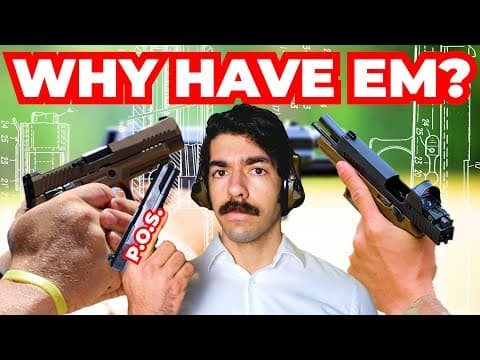
Military handguns, while often debated and developed at great expense, play a minimal role in combat effectiveness. This article explores the historical context, usage statistics, and the evolution of military pistols, concluding that their significance is largely overstated in modern warfare.
Military handguns, often referred to as pistols or sidearms, have sparked countless debates among enthusiasts and military personnel alike. Despite the millions spent on their development and procurement, the reality is that military pistols hold a minimal role in combat effectiveness. This article delves into the history, usage, and evolution of military pistols, ultimately concluding that their significance is largely overstated in modern warfare.
In the arms rooms of the United States military, two tan-colored pistols dominate: the M17 and M18. The M18 is a slightly shorter version of the M17, with the Navy, Air Force, and Marine Corps primarily using it, while the Army uses the M17, except for military police who opted for the M18. Both models are based on the Sig Sauer P320, adopted by the Department of Defense in 2017 after a costly competition that totaled $580 million.
To understand the current relevance of military pistols, we must look back at their historical context. The modern use of pistols began in the early 19th century with the advent of revolvers. Initially, these firearms were status symbols for officers and were rarely used effectively in combat. As military tactics evolved, pistols became more common among troops who were not primarily infantry, such as artillery crews and support personnel.
During World War I, despite the brutal trench warfare that favored close-quarters combat, pistols accounted for less than 0.1% of kill/wounding shots. This trend continued into World War II, where the proportion of pistol use decreased even further. The statistics reveal that while pistols were present, they played a negligible role in the overall combat effectiveness of military operations.
As warfare evolved, so did the technology behind firearms. The introduction of semi-automatic pistols like the 1911 during World War I marked a significant advancement. However, the role of the pistol remained largely unchanged, with rifles becoming the primary weapon for most troops. The compact size and semi-automatic nature of pistols provided advantages in specific scenarios, but they were not decisive in major battles.
In modern military operations, the majority of personnel carry rifles instead of pistols. The evolution of rifles has led to smaller, more versatile designs that are effective in various combat situations. The M4, for example, is compact enough for use in tight spaces while still being effective at longer ranges. This shift has rendered the traditional role of the pistol increasingly obsolete.
Today, only two groups of military personnel typically carry pistols into combat: those in high-ranking positions or specialized roles, and elite units that may require a backup weapon. However, even in these cases, the pistol is often used only in emergencies. The reality is that most troops would be better served carrying a rifle, which offers greater firepower and versatility.
While the specific model of pistol may not significantly impact combat outcomes, standardization across military branches is crucial. The military's decision to adopt a single model helps streamline training and maintenance, ultimately saving costs. However, the actual performance differences between various models are often negligible in the context of modern warfare.
In conclusion, while military pistols have a storied history and continue to be a topic of debate, their actual impact on combat effectiveness is minimal. The evolution of firearms has led to a landscape where rifles dominate, and the role of the pistol has diminished significantly. As military tactics and technology continue to advance, it is clear that the focus should remain on optimizing the primary weapon systems rather than getting caught up in the minutiae of sidearm specifications. Military handguns may still have their place, but they are not the decisive factor in modern warfare.