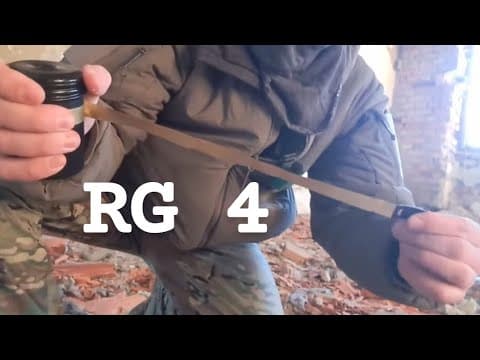
The RG4 is a unique Czechoslovakian impact grenade that operates differently from conventional grenades. With a lightweight design and specific operational mechanics, it raises safety concerns and has received mixed reviews regarding its effectiveness in combat situations.
In this article, we delve into the Czechoslovakian RG4 assault impact hand grenade, a device that stands out due to its unique design and operational mechanics. This grenade is an evolution of the earlier RG34 model and is classified as an offensive type of grenade.
The RG4 grenade weighs a total of 320 grams, containing 5 grams of TNT and 5 grams of a penite booster. These grenades are packaged in a square crate, with 25 pieces per crate. The lethal radius of the RG4 is estimated to be around 10 meters, although this may be optimistic given the lack of pre-fragmentation in its design. The grenade features a thin metal body and is designed to be modified into a defensive type by adding a special jacket, which increases its weight to 475 grams and extends its lethal radius to 15 meters.
The RG4 operates on a unique principle that differs from conventional grenades. The grenade consists of two TNT blocks that are not attached to any part of the grenade, allowing them to move freely within the thin metal casing. The design includes a firing pin and a primer that are activated upon impact.
To understand how the RG4 functions, consider the following:
When the grenade is thrown, the inertia of the TNT blocks causes the primer to be struck, leading to detonation upon impact with the ground. This mechanism is sensitive to various conditions, including snow and water, which can also trigger the grenade.
Interestingly, a training variant of the RG4 exists, designed to be reloadable. This version allows for practice without the risks associated with live grenades. Upon landing, the training grenade releases a puff of white smoke, indicating its impact location. This variant is crucial for training purposes, as it helps users learn the proper throwing techniques without the dangers of live ammunition.
To effectively throw the RG4 grenade, one must:
One of the significant safety concerns with the RG4 is its sensitivity. If the grenade is on the ground without the safety pin, any movement could trigger an explosion. This makes handling and deployment in close quarters particularly risky.
The RG4 grenade presents a fascinating case study in military design. While it showcases innovative engineering, its operational mechanics raise several concerns regarding safety and effectiveness. Compared to other grenades, such as the Soviet RGD-5, the RG4 appears to be less reliable, particularly in close-quarter battle scenarios. The complexity of its design may have led to higher manufacturing costs, raising questions about its practicality during its time of production in Czechoslovakia.
In summary, while the RG4 is an interesting piece of military hardware, its design flaws and operational challenges suggest that it may not be the best choice for modern combat situations. The insights gained from examining this grenade contribute to a broader understanding of military technology and its evolution over time.