Heavy Gustav, commissioned by Adolf Hitler, was the largest artillery gun ever built, weighing 1,350 tons and capable of firing 7-ton shells. Despite its impressive specifications, it proved to be ineffective in battle, firing only 48 shots with questionable accuracy before being deemed a strategic failure.
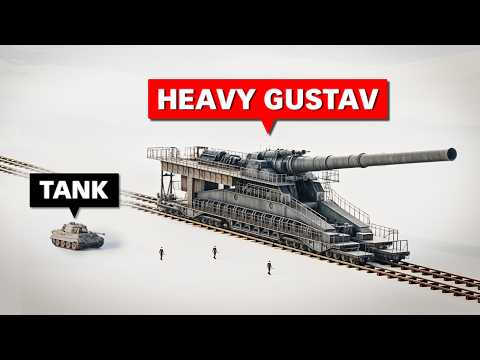
Heavy Gustav stands as a testament to the extremes of military engineering during World War II. This colossal weapon, weighing 1,350 tons and boasting a barrel length of 32 meters, was designed to breach the formidable Maginot Line and other fortified positions. Commissioned by Adolf Hitler, Heavy Gustav was not just a weapon; it was a symbol of Nazi ambition and military might.
In the late 1930s, as Hitler prepared for war, he was troubled by the heavily fortified Maginot Line along the French-German border. To counter this, he ordered the construction of the largest cannon the world had ever seen, hoping it would provide a decisive advantage in battle. The project was shrouded in secrecy, with internal documents referring to it only as the "Gustaf device."
The construction of Heavy Gustav was a monumental task, requiring 4,000 workers for setup and an additional 1,200 soldiers to operate it. The cannon was designed to be transported on railway tracks, weighing 1,350 tons and rolling on 40 axles with 80 wheels. Its caliber measured 80 cm, and the shells it fired weighed up to 7 tons each, capable of penetrating 6 meters of reinforced concrete.
By the time Heavy Gustav was ready for deployment in 1941, the strategic landscape had shifted. The Nazis had bypassed the Maginot Line and invaded France through Belgium. However, the cannon was soon needed on the Eastern Front, particularly during the siege of Sevastopol, known for its strong defenses.
Transporting Heavy Gustav to the battlefield was no small feat. The cannon had to be disassembled and loaded onto five trains, totaling 100 cars, and transported through Poland. Once at the front, soldiers laid 1,200 meters of railway tracks to set it up. The cannon's barrel could not be rotated, necessitating the movement of the entire weapon to adjust its aim.
After three days of assembly, Heavy Gustav was finally ready to fire at Fort Stalin, a heavily fortified Soviet position. On the day of its first shot, the Soviet soldiers were unaware that they were the target of the largest cannon ever built. However, the initial shots missed their mark, with the first shell landing 120 meters away from the target.
Over the course of its deployment, Heavy Gustav fired a total of 48 shots, expending 360 tons of ammunition. Despite the initial expectations, only three shots were officially recorded as hits, and even those were questionable. The cannon's accuracy was severely hampered by its size and the rapid wear of the barrel, which became ineffective after just a few shots.
Heavy Gustav's deployment was a strategic and economic disaster. Despite its intended purpose as a fearsome weapon, it proved to be largely ineffective in combat. After the war, Hitler ordered the destruction of the cannon to prevent it from falling into enemy hands. Ultimately, Heavy Gustav served more as a propaganda tool than a practical weapon, showcasing the delusions of grandeur that characterized much of the Nazi regime.
Heavy Gustav remains a fascinating yet sobering example of military ambition gone awry. It highlights the lengths to which nations will go in the pursuit of power and the often tragic outcomes of such endeavors. The story of this colossal artillery piece serves as a reminder of the futility of war and the importance of strategic planning over sheer size and firepower.