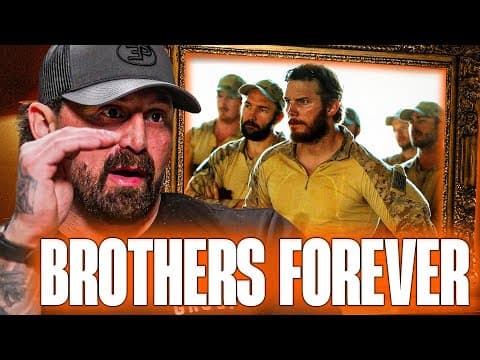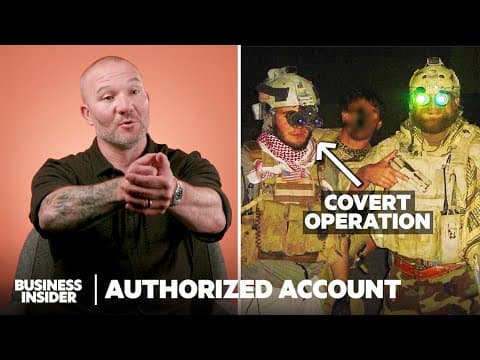
Shawn Ryan, a former Navy SEAL, shares insights into the rigorous training, intense missions, and the challenges faced during and after service. He discusses the camaraderie among SEALs, the realities of combat, and his personal journey through addiction and recovery after leaving the military.
My name's Shawn Ryan, and I served as a Navy SEAL for five and a half years. In this post, I will share everything I am authorized to tell you about the life of a SEAL, from the grueling training to the intense missions and the challenges of transitioning to civilian life.
Going to Basic Underwater Demolition/SEAL (BUD/S) training is akin to getting kicked in the nuts. You know it’s going to be tough, but you can’t truly prepare for it. The training is designed to test your physical endurance and mental toughness.
In the SEAL teams, there is a strong emphasis on accountability. Hazing is common, and there is no room for complacency. Each member has a critical role, whether as a communications specialist or a lead sniper. If you’re not performing at your best, you risk being removed from the team. The motto is simple: work hard, play hard.
The relationships formed in the SEAL teams are incredibly close. You eat, sleep, and grieve together, creating a bond that often surpasses family ties. Off-duty time often involves socializing, but on deployment, downtime typically consists of workouts and video games.
Many people falsely claim to be SEALs. In the past, we would encounter individuals bragging about their supposed SEAL status in bars. This often led to humorous consequences, such as being taped to a flagpole when the truth came out.
The primary rule in the SEAL teams is to maintain a balance between work and play. As long as you show up ready to perform, your off-duty activities are your business.
My first mission as a SEAL was in Haiti in 2004 during a period of civil unrest. We conducted reconnaissance missions to assess the situation, which was chaotic and dangerous. Although it was not action-packed, it ignited my desire for more intense missions.
One of my most intense missions occurred in Baghdad during an election. We worked alongside conventional units that were frequently ambushed. Our role was to train these units and assist them in real-world missions, often resulting in swift retaliation against the attackers.
During one operation near a dangerous village, we were compromised. I witnessed armed individuals preparing to plant an IED. Despite the chaos, we managed to communicate with our team and ultimately survived the encounter, thanks to the support of our fellow soldiers.
SEALs are trained to use a wide range of weapons, including sniper rifles, machine guns, and grenade launchers. My primary weapon was an M4 with a suppressor, which is often misunderstood as a silencer. The suppressor reduces noise but does not eliminate it entirely.
Familiarity with various weapons is crucial, especially when operating in enemy territory where you may need to use the enemy's weapons. This adaptability is essential for survival and mission success.
BUD/S consists of several phases, starting with intense physical training. Hell Week is notorious for its extreme demands, requiring candidates to endure sleep deprivation and harsh conditions. Completing Hell Week is a significant milestone, celebrated with a ceremony and a pizza.
The dive phase focuses on scuba training, where candidates learn to handle underwater challenges. The land-warfare phase involves learning demolition and firearms, allowing SEALs to master essential combat skills.
I left the SEALs for various reasons, including a desire for more action and concerns about the long-term effects of military life on personal relationships. Many veterans struggle with the transition, often facing issues like divorce and disconnection from family.
After leaving, I attempted various careers, including real estate and firefighting, before finding a role as a contractor for the CIA. This position offered a higher salary and more flexibility in deployment cycles.
Post-service life can be challenging. I struggled with addiction, using various substances to cope with the adrenaline withdrawal and the lack of a structured mission. My life spiraled into a cycle of substance abuse, which I eventually overcame through therapy and support.
I discovered that many veterans face similar challenges. There are resources available, including nonprofits focused on mental health and recovery. My journey through psychedelics provided profound insights and helped me regain control of my life, leading to sobriety and a renewed connection with my family.
The life of a Navy SEAL is filled with intense experiences, both in training and on missions. However, the transition to civilian life can be just as challenging. Sharing these stories is essential to provide hope and support to those who have served and are navigating their own journeys.
If you found this account insightful, please subscribe and share your thoughts on topics you’d like to see covered in the future.