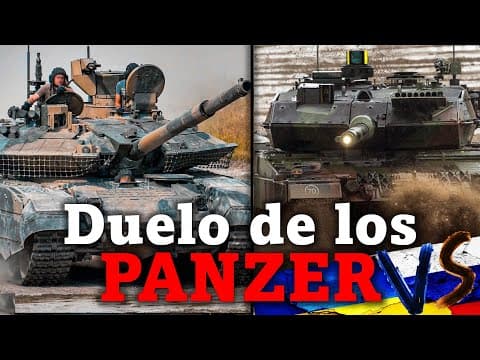
This blog post compares the Leopard 2 and T-90M tanks, analyzing their performance in various combat scenarios in Ukraine. The Leopard 2 excels in urban combat and offensive operations, while the T-90M shows advantages in maneuverability and protection. Overall, the Leopard 2 is deemed superior in most scenarios, but logistical and economic factors may influence operational decisions.
The battlefield of Ukraine has become a modern arena for tank warfare, reminiscent of historical confrontations like the Battle of Kursk in 1943. In this analysis, we will compare two of the most advanced tanks currently deployed: the German Leopard 2 and the Russian T-90M. Both tanks represent the pinnacle of military technology, yet they embody different design philosophies and operational capabilities.
The Leopard 2 is an evolution of the original Leopard 2 design from the 1980s, optimized for high-intensity warfare in open fields. Its design philosophy is rooted in Cold War strategies, focusing on frontal armor protection and firepower.
In contrast, the T-90M is the latest iteration of the T-90 series, incorporating lessons learned from recent conflicts in Chechnya, Syria, and Iraq. It emphasizes all-around protection and adaptability to asymmetric warfare, making it suitable for urban combat scenarios.
Urban environments present unique challenges for armored vehicles. In Mariupol, the Leopard 2's superior engine power and design allow it to clear obstacles like barricades and destroyed vehicles more effectively. Its weight and height give it a bulldozer-like capability, earning it the first point in this scenario.
However, the T-90M's smaller size allows for better maneuverability in tight urban spaces, enabling it to hide behind partially destroyed buildings. This advantage in urban maneuverability grants the T-90M a point in this category.
In terms of firepower, the T-90M's remote-controlled heavy machine gun outperforms the Leopard 2's MG42, allowing it to engage targets on rooftops effectively. The T-90M also features a design that enhances situational awareness for the crew, reminiscent of German innovations from World War II. This gives the T-90M another point.
When it comes to protection, the Leopard 2 has excellent frontal armor but is vulnerable on its sides. The T-90M, with its advanced reactive armor and all-around protection, secures the final point in this scenario.
In offensive operations, tanks typically operate in larger formations. The Leopard 2's MTU Friedrichshafen engine is designed for durability and performance, making it less likely to fail during extended operations. This reliability is crucial during intense offensives, giving the Leopard 2 a significant advantage.
The T-90M, while easier to repair, may encounter more mechanical issues during prolonged engagements, which could hinder its effectiveness. The Leopard 2's superior engine performance allows it to tackle obstacles that the T-90M might struggle with, earning it another point.
Crew fatigue is another factor; the Leopard 2's four-member crew can distribute tasks more effectively than the T-90M's three-member crew, leading to less fatigue during operations. This further solidifies the Leopard 2's advantage in this scenario.
In defensive scenarios, the Leopard 2's powerful cannon and excellent optics make it formidable at longer ranges, where it can exploit its superior firepower. Its frontal armor is nearly impenetrable at distances over 2 km, allowing it to engage effectively while remaining protected.
The T-90M, while capable, may struggle to find advantageous firing positions due to its engine limitations. However, it does possess the capability to launch missiles like the Invar M, which can reach targets up to 5 km away, providing it with a unique advantage in specific situations. This earns the T-90M a half-point in this scenario.
In summary, the Leopard 2 A6 outperforms the T-90M in two out of three combat scenarios, scoring a total of 7 points compared to the T-90M's 4.5 points. While the Leopard 2 demonstrates superior capabilities in urban combat and offensive operations, the T-90M's advantages in maneuverability and protection cannot be overlooked.
Logistical and economic considerations also play a significant role in the operational deployment of these tanks. The cost-effectiveness of the T-90M may influence decisions regarding its use in the ongoing conflict in Ukraine. Ultimately, the choice between these two tanks will depend on the specific operational context and strategic objectives of the forces involved.