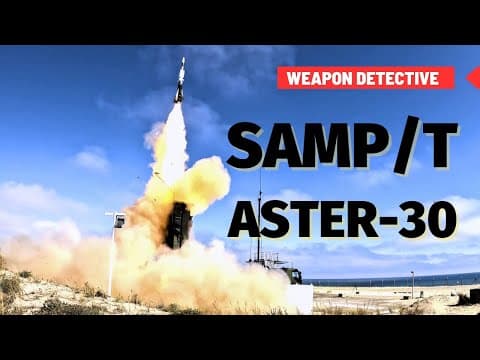
The SAMP/T, featuring the Aster 30 missile, is a cutting-edge air defence system currently deployed in Ukraine. This blog post explores its capabilities, history, and potential impact on modern warfare, particularly in the context of the ongoing conflict.
The SAMP/T is a land-based air defence system that utilizes the Aster 30 missile, recognized as one of the best surface-to-air missiles in the Western world. Currently, it is being tested in the ongoing conflict in Ukraine, providing an opportunity to evaluate its effectiveness in real combat conditions. This article delves into the SAMP/T's features, history, and its potential implications for modern warfare.
The SAMP/T is designed to counter a variety of aerial threats, including aircraft, tactical ballistic missiles, standoff missiles, cruise missiles, and anti-radiation missiles. It is considered one of the top systems in its class, at least theoretically. The system's name, SAMP/T, stands for "Sol-Air Moyenne-Portée/Terrestre," which translates to "Surface-to-Air Medium-Range/Land-based" in French. It is also referred to as FSF SAMP/T, where FSF stands for "Famille de Sol-Air Futurs," meaning "Future Surface-to-air Family." The French Army designates it as SAMP/T Mamba, with "Mamba" symbolizing a fast-moving and highly venomous snake, as well as an abbreviation for "Moyen de défense Anti-Missile Balistique et Aérobie," or "ballistic and agile anti-missile defence."
The development of the SAMP/T began in the early 1980s when France and Italy sought to replace older air defence systems like the Crotale and Aspide. Initially focused on a ship-based missile, the project shifted towards a land-based variant after the U.S. air strike on Libya in 1986 highlighted the inadequacies of existing anti-ballistic missile capabilities. This led to the inception of the Aster 30 missile and the SAMP/T program in 1989.
By 1997, France and Italy agreed to continue the development of the SAMP/T independently, and the first operational battery was delivered to France in 2010. The Aster 30 missile has since evolved into two main variants: Block 1, effective against ballistic missiles up to 600 kilometers, and Block 1NT, which can intercept targets up to 1,500 kilometers away. An advanced Block 2 version is also in development, aimed at countering highly maneuverable ballistic missiles.
The SAMP/T system comprises several components, including a command and control vehicle, radar vehicle, and multiple firing units. The Arabel 3D multifunction radar, with a range of 60 kilometers, can track up to 100 targets simultaneously and provides comprehensive surveillance coverage. The system's flexibility allows for integration with other radars and sensors, extending its detection range to 120 kilometers.
Each firing unit can prepare two Aster 30 missiles simultaneously, with a reaction time of less than 10 seconds. The Aster 30 missile itself is launched vertically and features a two-stage design with a solid-propellant booster. It has an effective range of 25 to 30 kilometers against guided missiles and 70 to 100 kilometers against aircraft. The missile's warhead creates a lethal radius of 2 meters upon detonation.
The SAMP/T can engage multiple targets simultaneously, with the capability to handle saturation attacks effectively. Current users of the SAMP/T include France, Italy, Singapore, and Ukraine, with Turkey having previously signed a contract for acquisition that was later put on hold.
The SAMP/T was developed as a response to the limitations of existing systems like the U.S. Patriot missile. While the Patriot has been combat-proven, its design inherited several disadvantages, such as limited coverage and effectiveness against ballistic missiles. The SAMP/T, with its 360-degree coverage and advanced capabilities, presents a more modern solution to air defence needs.
In January 2023, France and Italy announced the provision of four SAMP/T firing units and 700 Aster 30 missiles to Ukraine. Training for Ukrainian crews commenced shortly thereafter, with the first unit delivered in May 2023. The integration of the SAMP/T with advanced radar systems enhances its operational effectiveness, allowing for better tactical deployment against various aerial threats.
Despite its advanced capabilities, the SAMP/T faces challenges, particularly regarding cost. The high expense of the Aster 30 missiles raises concerns about economic viability, especially in the face of low-cost drone threats. The potential for economic dilemmas in warfare, where the cost of advanced systems may not justify their use against cheaper alternatives, is a significant consideration for military planners.
The SAMP/T and its Aster 30 missile stand at a critical juncture in modern military history. As it is tested in the ongoing conflict in Ukraine, its performance may redefine perceptions of land-based air defence systems. The outcomes of its deployment could lead to broader acceptance and integration of advanced missile systems in military strategies worldwide. The coming months will reveal whether the SAMP/T lives up to its promise as a formidable air defence solution.