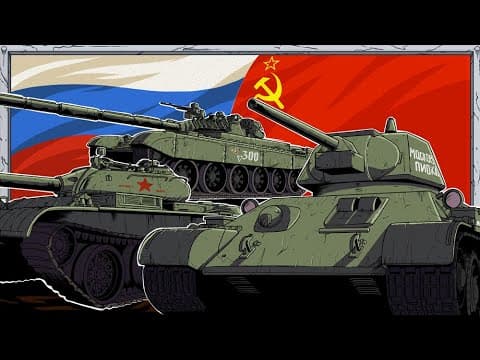
This blog post explores the evolution of Russian tanks from the early 20th century through the Soviet era to the modern Russian Federation, highlighting key designs, innovations, and their impact on armored warfare.
The history of Russian tanks is a fascinating journey that showcases the evolution of armored warfare. From the early experiments of the Russian Empire during World War I to the advanced designs of the modern Russian Federation, the development of tanks has been marked by innovation and adaptation to the changing landscape of military conflict.
The Russian Empire began its foray into armored warfare during World War I. In August 1914, designer Alexander Perak Hofshikov was tasked with creating an all-terrain vehicle for the Tsar's army. This led to the development of the Vesticot, which translates to "all-terrain vehicle." With a top speed of 42.6 kilometers per hour and iron armor plating, the Vesticot was one of the first Russian tanks, although little information survives about this early experiment. The project was ultimately abandoned in 1916 due to the fall of the Russian Empire.
Following the revolution, the Soviet Union sought to enhance its armored capabilities. A significant turning point came when American weapons designer Walter J. Christie sold his design for a fast tank to the Red Army. The first of these tanks, the B-2, was initially shipped to the Soviet Union as agricultural tractors to circumvent an arms embargo. The B-2 featured incredible mobility and could reach speeds of up to 55 kilometers per hour.
The B-2 was eventually replaced by the BT-7, which remained in service until the end of World War II. The BT-7 could reach a top speed of 86 kilometers per hour on roads and 50 kilometers per hour off-road. In 1938, the BT-20 light tank was introduced as a precursor to the legendary T-34. The T-34 would go on to become one of the most effective tanks in military history, with various models serving in conflicts worldwide.
The T-34 made its debut in 1940 and saw action throughout World War II. The basic model weighed 26.8 tons and had a crew of four, armed with a 76.2-millimeter main gun. The T-34 was known for its sloped armor, which provided better protection against enemy fire. The 1943 variant, the T-34-85, featured an upgraded 85-millimeter gun and improved armor thickness, making it a formidable opponent on the battlefield.
After World War II, the Soviet Union continued to innovate. The T-44, introduced in 1944, was a complete redesign that featured a maximum armor thickness of 120 millimeters. The T-54, which succeeded the T-44, became the most widely used tank in the Eastern Bloc, with over 35,000 units produced. The T-54 introduced several modernizations, including improved armor and stabilization systems.
The T-55 built upon the T-54's innovations, focusing on protection and survivability. Over 27,500 units were produced, and the tank underwent numerous upgrades throughout the 1970s and 80s. The T-62, introduced in 1961, featured a 115-millimeter smoothbore cannon and excellent armor for its time, leading to its modernization as the T-62M.
The T-64, introduced in 1963, marked a significant advancement in tank design with increased armor thickness and a reduction in crew size. The T-72, which followed, became known for its adaptability and continued to receive upgrades throughout its service life. The T-80, introduced in 1976, combined components from previous models and featured advanced protection systems.
The T-90, introduced as the third-generation main battle tank for the Russian Federation, has been in service since the 1990s. The latest model, the T-90AM, features advanced armor and weaponry. The T-14 Armata, introduced in 2015, represents the cutting edge of Russian tank design, with a fully mechanized turret and advanced protection systems.
The evolution of Russian tanks reflects a continuous pursuit of innovation and adaptation to the demands of modern warfare. From the early experiments of the Tsarist era to the advanced designs of the Russian Federation, each tank model has played a crucial role in shaping armored warfare strategies. As technology continues to advance, the legacy of Russian tank design remains a significant aspect of military history.