The French Navy's Charles De Gaulle aircraft carrier, though smaller than its American counterparts, boasts significant advantages such as CATOBAR technology, interoperability with US Navy aircraft, and a high aircraft availability rate, making it a formidable force in naval operations.
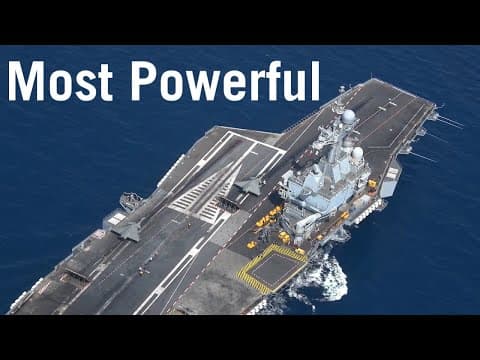
The French Navy’s Charles De Gaulle aircraft carrier is recognized as the most powerful aircraft carrier in the world, outside of the American supercarriers. Despite being about 40% smaller than the British Queen Elizabeth-class carriers and even smaller than the Russian Admiral Kuznetsov and the Chinese Shandong, the Charles De Gaulle exemplifies the adage, "It’s not about the size, but what you can do with it."
One of the primary advantages of the Charles De Gaulle is its use of Catapult Assisted Take-Off Barrier Arrested Recovery (CATOBAR) technology. This system allows for the launch of heavier and larger aircraft compared to carriers that rely on ski-jump ramps, which limit take-off weight and, consequently, the amount of fuel and munitions that can be carried.
The ability to launch heavier aircraft means that those deployed from the Charles De Gaulle can carry more weapons and have a longer operational range. Notably, the Charles De Gaulle is the only non-American carrier capable of launching early warning aircraft like the E-2C Hawkeye, which can detect targets up to 300 nautical miles away. This capability is crucial, as other carriers without catapults must rely on helicopters for early warning, which have a significantly reduced surveillance range.
Another significant advantage of the Charles De Gaulle is its interoperability with American supercarriers. It is the only aircraft carrier in the world that can operate all types of US Navy aircraft, including the C-2 Greyhound, F/A-18, and E-2D Hawkeyes. This interoperability enhances the operational flexibility of both French and American naval forces.
The carrier is equipped with a three-wire arresting system, two deck edge elevators, and two American-built C-13 catapults. Each catapult can launch a 25-ton aircraft at 145 knots in under two seconds. However, due to their shorter length compared to American catapults, the Charles De Gaulle's aircraft experience higher G-forces during launch, ranging from 4 to 5 Gs, compared to the 3 to 4 Gs experienced on American supercarriers.
The Charles De Gaulle can carry up to 40 aircraft, including 23 fixed-wing aircraft and two helicopters stored in the hangar bay, with additional aircraft on the flight deck. Typically, the carrier operates between 24 to 30 Dassault Rafale-Marine multirole fighter aircraft, which can create a controlled operational area of approximately 370 to 430 miles in diameter.
The carrier also embarks two Hawkeyes, one AS565 Panther maritime intelligence helicopter, and one AS365F Dauphin helicopter, known as "Pedro," which is crucial for pilot rescue operations during flight missions. The presence of Pedro allows for rapid response in case of pilot ejection, significantly increasing survival chances.
The Charles De Gaulle boasts an impressive aircraft availability rate of over 94%, meaning that out of the 36 Rafales on board, 34 are typically ready for flight. This high availability is supported by a 24/7 aircraft repair shop with over a million spare parts in inventory. In comparison, the F/A-18 availability rate on American supercarriers was around 43% in 2014, improving to 80% by 2023.
The Charles De Gaulle is also notable for being one of the few nuclear-powered aircraft carriers in the world, alongside American vessels. This nuclear propulsion allows the carrier to operate continuously at 25 knots for about five years without refueling, although it typically requires refueling every 7 to 10 years. The nuclear reactors enable rapid acceleration, reaching 20 knots in just four minutes, a significant advantage over conventionally powered carriers.
However, the nuclear reactors have faced criticism for being underpowered, as they were adapted from submarine designs rather than developed specifically for the carrier. This has resulted in limitations on the carrier's top speed, which is capped at 27 knots, compared to the higher speeds of American supercarriers.
The Charles De Gaulle has faced its share of challenges, including a significant scandal involving defective propellers. In 2000, one of the carrier's propellers disintegrated during a voyage, leading to an investigation that revealed poor manufacturing practices. The situation was exacerbated by a fire that destroyed critical design documents, complicating the investigation. Ultimately, the carrier had to rely on older propellers from a decommissioned vessel until new ones could be installed.
Despite being a powerful asset, the Charles De Gaulle's status as the only aircraft carrier in the French Navy poses a strategic risk. Maintenance periods can leave the navy without carrier capabilities, a concern that led the Royal Navy to build two Queen Elizabeth-class carriers. France had initially planned to construct two nuclear-powered carriers but ultimately only completed the Charles De Gaulle due to funding issues and delays.
Looking ahead, the French government has announced plans for the Charles De Gaulle to retire in 2038, to be replaced by the new aircraft carrier, Porte-avions de nouvelle génération (PANG). This new carrier will feature advanced technologies, including electromagnetic catapults and new nuclear reactors, positioning France to maintain its naval capabilities into the future.
In conclusion, while the Charles De Gaulle may be smaller than its American counterparts, its advanced technology, interoperability, and operational capabilities make it a formidable force in modern naval warfare.