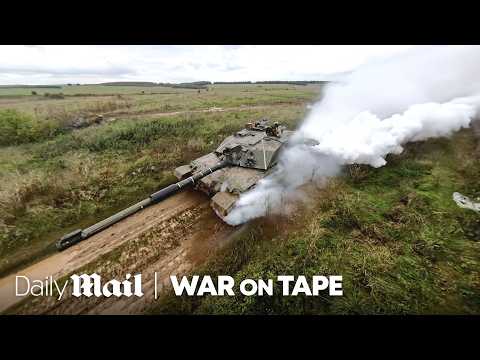
The Challenger 2 tank, known for its exceptional protection and combat capabilities, has proven to be a formidable asset in Ukraine. Despite its heavy armor and advanced weaponry, it faced challenges in the current conflict, leading to the destruction of only one tank in combat. This article explores the tank's design, strengths, weaknesses, and the circumstances surrounding its recent loss.
The Challenger 2 tank, a symbol of British military engineering, has gained recognition as one of the best-protected tanks in the world. Donated to Ukraine as part of military support, it has demonstrated remarkable resilience in combat, with only one confirmed loss in 18 months. This blog post delves into the design features that make the Challenger 2 so formidable, the circumstances surrounding its recent destruction, and the implications for modern warfare.
The Challenger 2 was the first Western tank to be sent to Ukraine, with the UK providing 14 units. Its reputation for durability stems from its advanced armor and design, which prioritize crew survival and combat effectiveness. Historically, this tank had never been lost to enemy fire until recently, making the footage of its destruction particularly significant.
Recent footage captured by Ukraine's 82nd Brigade shows the wreckage of a Challenger 2 tank near the town of Robota. The clips reveal critical details about the tank's condition post-destruction:
Based on the evidence, it is believed that the Challenger 2 struck an anti-tank mine, leading to its immobilization. Subsequently, Russian forces likely targeted the tank with additional explosives, possibly from a missile or drone, igniting the fuel and ammunition and resulting in a catastrophic kill (K kill). Fortunately, reports suggest that all four crew members escaped unharmed, highlighting the tank's protective capabilities.
The Challenger 2 is renowned for its Dorchester armor, a composite material designed to withstand various forms of attack. This armor is concentrated on the front, where it is most vulnerable to enemy fire. However, the tanks sent to Ukraine lack additional armor panels that could further enhance protection.
The tank is equipped with the L30A1 cannon, one of the most accurate guns on any Western battle tank. Its rifled barrel allows for the use of high explosive squash head (HESH) rounds, which are effective against both armored targets and fortifications. This precision makes the Challenger 2 a formidable opponent in tank-on-tank combat.
Despite its strengths, the Challenger 2 faces challenges in the ongoing conflict in Ukraine. The nature of modern warfare has shifted, with tank-on-tank engagements becoming rare. Ukraine's tank fleet is limited, with only about 1,000 tanks available, compared to Russia's approximately 2,000. This disparity has led to a cautious approach, with Ukrainian forces primarily using tanks for indirect fire support rather than direct assaults.
Training Ukrainian crews to operate the Challenger 2 has been a priority. The training process, although condensed to five weeks, has proven effective. Crews have shown eagerness to learn and adapt, understanding the importance of mastering this advanced piece of equipment in a high-stakes environment.
The Challenger 2 tank exemplifies the intersection of advanced military technology and battlefield strategy. Its design prioritizes crew safety and combat effectiveness, making it a valuable asset in modern warfare. However, the realities of the current conflict in Ukraine highlight the complexities of tank warfare, where numbers and tactical deployment often outweigh individual tank capabilities. As the situation evolves, the Challenger 2 will continue to play a crucial role in Ukraine's defense efforts, showcasing the resilience and adaptability of its crew and design.