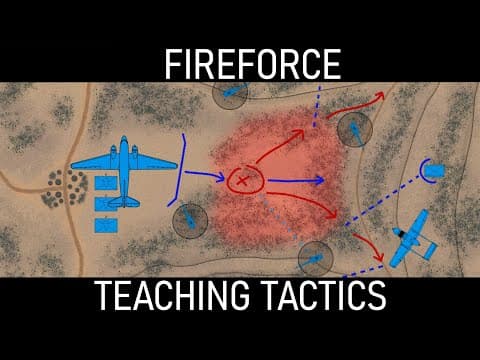
The Rhodesian Fireforce, a counterinsurgency tactic developed during the Rhodesian Bush War, showcased a unique blend of political miscalculations, military innovation, and geographical challenges. This blog post explores the origins, execution, and ultimate implications of the Fireforce strategy, revealing how it achieved tactical success while failing to secure a strategic victory in the long run.
Following the end of the Second World War, a wave of decolonization swept through the old European empires. These struggles for independence often turned violent, as colonial powers intervened militarily or revolutionary factions clashed over diverging visions of the future. The Cold War further complicated these conflicts, with superpowers using opposing sides as proxies. One notable conflict during this period was the Rhodesian Bush War, which lasted from 1965 until 1980 in what is now Zimbabwe.
In 1965, the British colony of Rhodesia declared itself independent, not to decolonize but to maintain its colonial legacy. The country was ruled by a minority of white settlers, numbering around 230,000 in a population of nearly 5 million. Britain refused to grant independence until a system of majority rule was implemented, which was unacceptable to Rhodesia's ruling minority, who feared for their safety and prosperity. Frustrated by Britain's insistence on majority rule, Rhodesia unilaterally declared independence on November 11, 1965.
The ensuing conflict can be described as a rebellion against a rebellion, as African nationalists, supported by the communist world, turned to violence to overthrow the unrecognized regime. The Rhodesian Bush War lasted 15 years, pitting Rhodesia's small and under-equipped security forces against a growing insurgency that enjoyed superpower support and utilized neighboring countries as staging areas.
In this context of international isolation and limited resources, the Rhodesian security forces developed innovative tactics to maximize their effectiveness. One of the most famous of these was the Fireforce, an aggressive aerial encirclement tactic that combined rapid helicopter landings, low-altitude parachute drops, and overhead airstrikes to trap large groups of insurgents. This tactic was characterized by its reckless nature, taking significant risks to maximize insurgent losses.
The Rhodesian Light Infantry (RLI), the undisputed masters of Fireforce, inflicted staggering casualty counts, achieving a ratio of 35 enemy casualties for each of their own. This made them one of the most lethal units in military history. However, despite these tactical successes, Rhodesia's bid for independence ultimately proved hopeless in the face of global isolation.
An analysis of Fireforce cannot overlook the political context of the Rhodesian War. The political leadership in Rhodesia fundamentally misunderstood the nature of the conflict, favoring an enemy-centric approach that sought to out-kill the insurgency rather than a population-centric approach that aimed to win the support of the local populace. The insurgency was inherently political, waged between opposing ideologies over the future of the state.
The Rhodesian government, led by Prime Minister Ian Smith and the Eurocentric Rhodesian Front party, framed the conflict as a battle against international communism, underestimating the internal political dynamics and the rise of African nationalism. This self-delusion reinforced the belief that the insurgency could be defeated by simply killing insurgents, rather than addressing the underlying issues of governance and support from the local population.
The Rhodesian security forces faced significant challenges in terms of manpower and equipment. With a population of nearly 5 million, the combined security forces numbered only in the low tens of thousands, many of whom were part-time reservists. The majority were low-intensity security units, with only a small portion deemed qualified for high-intensity Fireforce missions.
Due to international sanctions, the equipment available to the Rhodesian forces was often outdated, relying on aging British legacy equipment and improvised solutions. This scarcity of resources led to a focus on specialization, particularly in aviation assets, which became crucial for executing Fireforce operations.
Fireforce operations typically involved a combination of helicopter and parachute waves, with ground troops deployed to encircle and trap insurgents. The RLI, as the primary quick reaction force, was stationed at various bases across Rhodesia, ready to respond to insurgent activity. Each Fireforce mission was meticulously planned, relying on intelligence gathered from various sources, including local informants and reconnaissance.
The execution of a Fireforce mission involved several phases:
While Fireforce was tactically successful, inflicting significant losses on the insurgents, it ultimately served a flawed strategic approach. The Rhodesian leadership's belief that they could win the war through attrition blinded them to the realities of the insurgency and the growing support for the insurgents among the local population.
As the war progressed, the effectiveness of Fireforce diminished due to a shrinking manpower pool, deteriorating equipment, and a loss of intelligence. The insurgents adapted their tactics, and the Rhodesian forces found themselves increasingly isolated and demoralized.
In conclusion, the Rhodesian Fireforce represents a fascinating case study in counterinsurgency tactics. It highlights the interplay between political decisions, military innovation, and geographical challenges. While Fireforce achieved impressive tactical results, it ultimately failed to secure a strategic victory, illustrating the importance of aligning military tactics with broader political objectives in counterinsurgency operations. The lessons learned from the Rhodesian experience continue to resonate in contemporary discussions of military strategy and counterinsurgency.