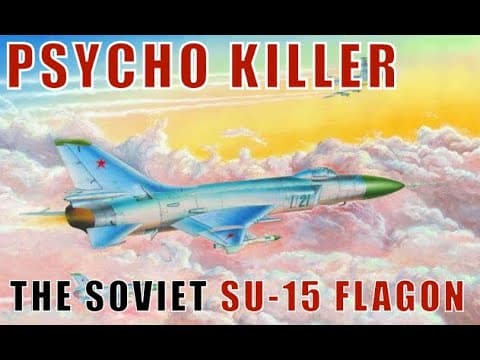
The SU-15 Flagon, a Soviet interceptor aircraft, played a notorious role during the Cold War, known for its deadly efficiency in intercepting civilian and military aircraft alike. Designed amidst political turmoil and technological challenges, the Flagon's legacy is marked by its operational history, including tragic incidents involving civilian airliners, showcasing the darker side of military aviation.
The SU-15 Flagon, a Soviet interceptor aircraft, occupies a unique and controversial position in the history of military aviation. Often referred to as the "psycho killer" of the Cold War, the Flagon was designed for high-speed interception but became infamous for its role in tragic incidents involving civilian aircraft. This blog post delves into the aircraft's development, operational history, and the events that defined its legacy.
The SU-15 was born out of a tumultuous period in Soviet aviation history. Its designer, Pavel Sukhoi, faced significant challenges, including a falling out with Stalin that nearly ended his career. After Stalin's death, Sukhoi's design bureau was reinstated, leading to the development of several aircraft, including the SU-7 and SU-9.
The Flagon's design was influenced by the Soviet military's shift towards twin-engine fighters, which were deemed safer than single-engine models. The initial project, designated T-58, faced numerous setbacks, including engine issues and the failure of missile development. Eventually, the design evolved into the SU-15, which featured advanced radar and weaponry.
The SU-15 was a large aircraft with a long fuselage primarily made of aluminum, designed for high-speed interception. It was powered by two turbojet engines, providing significant thrust and speed. The aircraft's radar systems were advanced for their time, allowing for effective target detection and engagement.
The SU-15 entered service in the mid-1960s and quickly became a key component of the Soviet air defense strategy. It was designed to intercept high-speed bombers and was equipped with various missiles, including the K-98 and K-60. Despite its impressive specifications, the Flagon faced criticism for its handling and reliability issues.
The Flagon's reputation as a "psycho killer" stems from several tragic incidents involving civilian aircraft. One of the most infamous events occurred on April 20, 1978, when a SU-15 shot down a Korean Airlines Boeing 707 that had strayed into Soviet airspace. The pilot, Captain Alexander Bozov, was ordered to engage the aircraft despite identifying it as a civilian airliner. The missile strike resulted in casualties, marking a dark chapter in the Flagon's history.
Another significant incident occurred on September 1, 1983, when a SU-15 shot down Korean Airlines Flight 007, which had mistakenly entered Soviet airspace. This event escalated tensions between the United States and the Soviet Union and highlighted the dangers of miscommunication and military protocol during the Cold War.
Despite its controversial history, the SU-15 Flagon served as a critical component of Soviet air defense throughout the Cold War. It was deployed to intercept various threats, including reconnaissance aircraft and potential bombers. The aircraft's speed and firepower made it a formidable opponent, although its limitations in engaging low-flying targets were evident.
The SU-15 Flagon remains a symbol of the complexities and dangers of Cold War aviation. Its design and operational history reflect the technological advancements of the time, as well as the darker aspects of military engagement. The Flagon's legacy is a reminder of the fine line between defense and aggression in the realm of military aviation, and its role in tragic incidents serves as a cautionary tale for future generations.