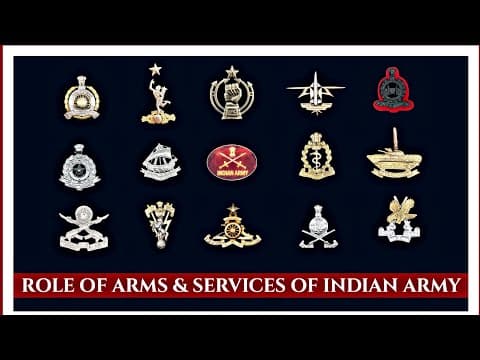
This blog post provides a concise overview of the Indian Army's structure, detailing the roles of combat arms, combat supporting arms, and services, along with insights into special forces and their operational significance.
The Indian Army is a complex organization structured into various categories, each playing a crucial role in maintaining national security. This post will provide a brief overview of the roles of all arms and services within the Indian Army, categorized into combat arms, combat supporting arms, and services.
The Indian Army is primarily organized into three main categories:
Combat arms are the frontline troops that engage directly with the enemy. They are essential for executing offensive and defensive operations. The main elements of combat arms include:
The Armored Corps is responsible for delivering firepower with speed at critical locations. They are the first to cross international boundaries during conflicts. Key assets include main battle tanks such as the T-90, T-72, and Arjun tank.
Mechanized infantry units consist of infantry fighting vehicles (IFVs) like BMPs, which accompany tanks into battle. They carry soldiers and are tasked with destroying enemy forces using lighter tanks.
Infantry is the backbone of the Indian Army, comprising foot soldiers who engage in hand-to-hand combat and hold ground during defensive operations. They play a significant role in active insurgency operations and are equipped with various weapons, including rifles, machine guns, rocket launchers, and grenade launchers.
Combat supporting arms provide essential support to combat arms, enhancing their operational effectiveness. Key components include:
Artillery units provide covering fire for advancing troops and are responsible for destroying enemy capabilities from a distance. They utilize long-range guns, howitzers, and multi-barrel rocket launchers.
The Army Air Defense protects the airspace from low-flying aerial threats and secures sensitive locations such as headquarters and ammunition depots. They employ advanced radar systems, self-propelled guns, and missile systems.
The Corps of Engineers supports the army by constructing defenses, laying minefields, and establishing logistical points. They are equipped with dozers, tractors, and various engineering tools.
This corps ensures effective communication and electronic support across the army, navy, and air force, focusing on operational connectivity and cybersecurity.
The Army Aviation Corps provides both combat and logistical support through airborne operations, particularly in frontier areas. They operate attack and utility helicopters.
The services category encompasses various support roles that ensure the smooth functioning of the army. Key elements include:
The ASC is the oldest and largest administrative corps, responsible for the procurement and distribution of supplies, including food and fuel.
The AOC manages the supply and maintenance of clothing, tools, and ammunition necessary for training and operations.
The EME is tasked with the repair and maintenance of equipment and weapon systems, as well as recovering vehicle casualties during operations.
Acting as the eyes and ears of commanders, the Intelligence Corps collects and analyzes data to inform operational decisions.
The AMC oversees health and hygiene advisories, conducts medical examinations, and ensures the well-being of troops.
The CMP maintains discipline and security within the army, handling prisoners of war and regulating traffic during conflicts.
The RVC manages the procurement and care of animals used in military operations, ensuring their health and training.
The JAG handles military legal matters and provides legal assistance in human rights issues.
This operational logistics arm provides trained manpower in areas where civilian labor is unavailable or undesirable due to security concerns.
The AEC is responsible for educational training and conducting promotional examinations for army personnel.
This corps manages all postal services for the defense forces.
The MNS is part of the armed forces medical services, providing nursing care to military personnel.
The Territorial Army serves as the second line of defense, with volunteers typically serving two to three months annually.
The DSC provides security at defense ministry sites and ensures the protection of defense installations.
The Indian Army's special forces, primarily the Parachute Regiment, operate in small teams behind enemy lines. They are divided into two main components: airborne infantry and special forces. The airborne battalions include the 5th, 6th, 7th, 23rd, and 29th Para, while the special forces battalions include 1st, 2nd, 3rd, 4th, 9th, 10th, 11th, 12th, and 21st Para.
The Indian Army's structure is designed to ensure comprehensive defense capabilities through its various arms and services. Each component plays a vital role in maintaining operational readiness and effectiveness, contributing to the overall security of the nation. Understanding these roles is essential for anyone interested in military operations and the strategic functioning of the Indian Army.